Poured Concrete vs Boulder Retaining Walls
Compare poured concrete and boulder retaining walls by cost, drainage, soil pressure, and lifespan to choose the right wall for your property.
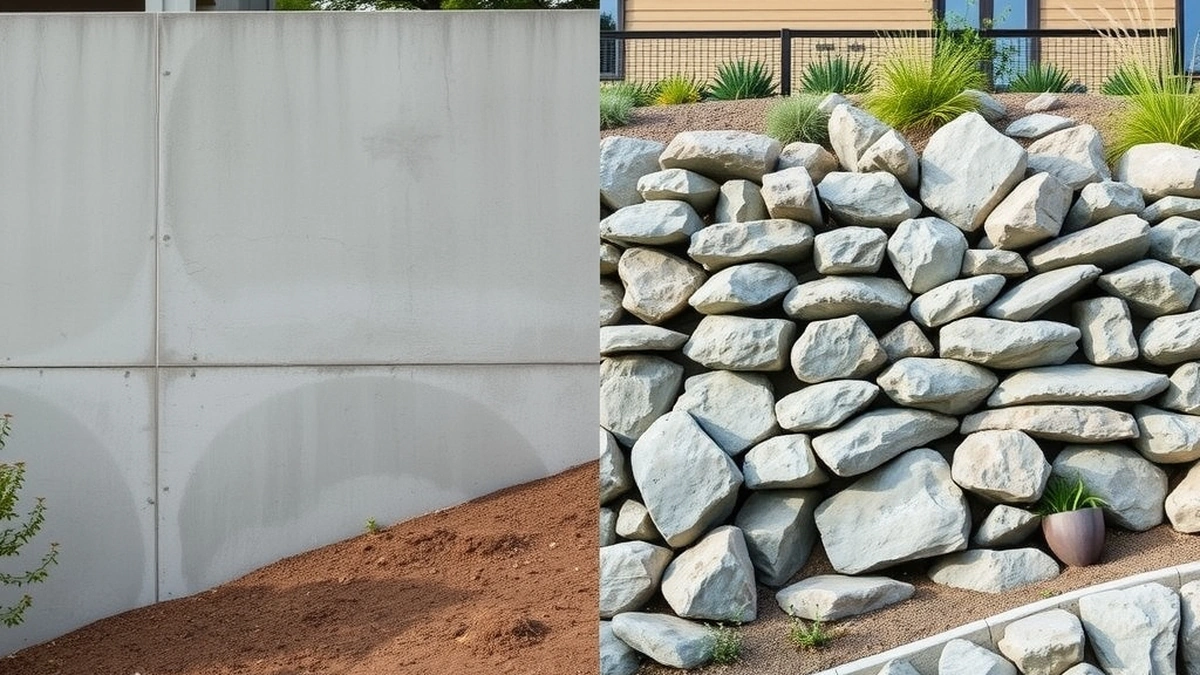
Poured concrete costs $25–60 per sq ft and boulder walls cost $20–45 per sq ft; concrete suits tight spaces and high loads, while boulders need more footprint but handle drainage well.
- Poured concrete cost
- $25–60 / sq ft
- Boulder wall cost
- $20–45 / sq ft
- Drainage and backfill
- $5–15 / sq ft
- Best for tight sites
- Poured concrete
- Best for natural look
- Boulder wall
Some links on this page are affiliate links.If you buy through them we may earn a commission at no extra cost to you. We do not accept payment for rankings. Read the full disclosure.
Poured concrete and boulder walls solve the same problem—holding back soil—but they do it differently. Poured concrete costs $25–60 per sq ft and works best where space is tight and soil pressure is high. Boulder walls cost $20–45 per sq ft and suit sites with room for a wider, more natural-looking structure.
How Each Wall Resists Soil Pressure
Soil pressure is the force that pushes against a retaining wall. It increases with wall height and with the weight of the soil behind it. Wet soil exerts more pressure than dry soil, which is why drainage matters more than block choice.
Poured concrete resists pressure through strength and rigidity. A concrete wall can be relatively thin—often 8 to 12 inches—and still hold back significant loads because the material itself is strong in compression and, when reinforced with steel, in tension. That makes poured concrete a strong choice for property lines, driveways, and other spots where you cannot afford to lose several feet of yard to a wide wall.
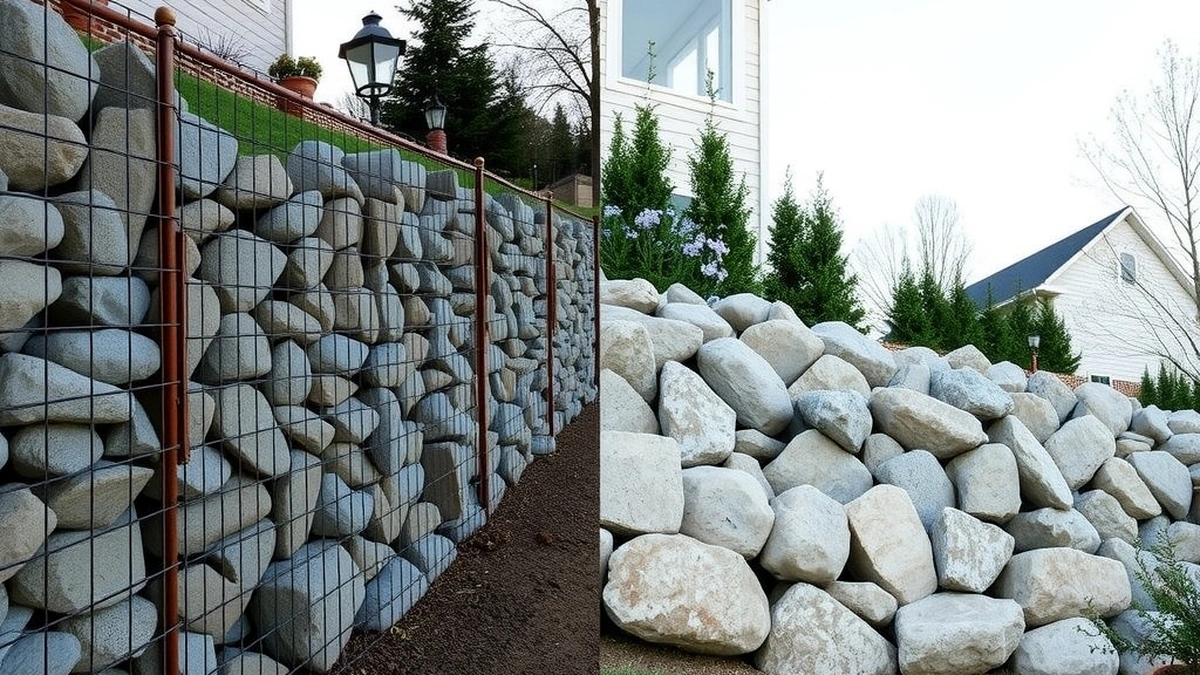
Boulder walls resist pressure through mass and friction. Individual boulders weigh hundreds or thousands of pounds, and the wall’s weight helps it push back against the soil. The tradeoff is footprint. A stable boulder wall often needs to be wider at the base than a poured concrete wall of the same height. If your lot is narrow, a boulder wall may not fit.
Drainage and Backfill Come First
Before choosing concrete or boulder, plan for water. Water trapped behind a wall creates hydrostatic pressure, which can crack concrete or shift boulders out of place. Every retaining wall needs a drainage system behind the face, typically perforated pipe surrounded by crushed stone, plus free-draining backfill.
Drainage and backfill add $5–15 per sq ft to the project. On a 100-square-foot wall, that is $500 to $1,500. Skipping it to save money is false economy; a wall that bulges or cracks will cost far more to repair than the drainage would have cost. For more on the full installation sequence, see our guide to retaining wall installation.
Cost Comparison by Material
Material costs are only part of the total. Labor, site access, excavation, and finishing all affect the final price. The figures below are installed cost estimates per square foot.
| Wall type | Installed cost per sq ft |
|---|---|
| Block wall | $15–35 |
| Poured concrete | $25–60 |
| Timber wall | $10–25 |
| Gabion | $20–40 |
| Boulder wall | $20–45 |
| Drainage and backfill | $5–15 |
Here is sample arithmetic for a 4-foot-tall wall that is 25 feet long, or 100 square feet.
Poured concrete at $25–60 per sq ft:
- Low: 100 × $25 = $2,500
- High: 100 × $60 = $6,000
Boulder wall at $20–45 per sq ft:
- Low: 100 × $20 = $2,000
- High: 100 × $45 = $4,500
Drainage and backfill at $5–15 per sq ft:
- Low: 100 × $5 = $500
- High: 100 × $15 = $1,500
Total poured concrete with drainage: $3,000 to $7,500. Total boulder wall with drainage: $2,500 to $6,000.
These are estimates. Actual quotes depend on local labor rates, boulder availability, and site conditions. For broader pricing context, see retaining wall cost per square foot and how much does a retaining wall cost.
Appearance and Site Fit
Poured concrete has a uniform, modern look. It can be left gray, stained, or stamped to resemble stone. Because it forms a solid face, it works well in urban and suburban settings where a clean edge matters. It also takes up less horizontal space, which matters when the wall sits near a fence, driveway, or foundation. If you are weighing a wall against a fence for a boundary, our comparison of retaining wall vs fence may help.
Boulder walls look natural and rugged. Each stone is different, so no two walls look identical. They blend well with landscaping, wooded lots, and rural properties. The downside is that boulders are heavy and irregular, so installation is slow and equipment-intensive. You also need room for the wall’s width. A boulder wall on a small city lot can overwhelm the space.
Lifespan and Maintenance
Both wall types can last decades when built on a proper footing with good drainage. Poured concrete may develop hairline cracks over time, especially if the soil settles unevenly. Small cracks can be sealed; larger structural cracks need professional assessment. Boulder walls can shift if individual stones settle, and vegetation may grow between the stones over the years.
Routine maintenance includes checking drainage outlets after heavy rain, keeping soil from washing out behind the wall, and watching for leaning or bulging. For upkeep schedules, see retaining wall maintenance. If damage appears, retaining wall repair covers common fixes.
When to Choose Poured Concrete
Choose poured concrete when:
- You have limited horizontal space.
- The wall must support heavy loads, such as a driveway or building foundation.
- You want a smooth, uniform finish.
- The site is accessible for concrete trucks and forming equipment.
When to Choose Boulder
Choose boulder walls when:
- You have room for a wider wall base.
- You prefer a natural, stone appearance.
- The site is rural or wooded and equipment can reach it.
- You want drainage gaps between stones as part of the design.
Bottom Line
Poured concrete costs $25–60 per sq ft and fits tight spaces with high soil pressure. Boulder walls cost $20–45 per sq ft and need more room but offer a natural look. Add $5–15 per sq ft for drainage and backfill regardless of which face you choose. Start with drainage and soil pressure, then pick the material that fits your site and budget. For help selecting a wall type overall, see best retaining wall. If you are considering doing the work yourself, read DIY retaining wall first to understand the limits of homeowner-built structures.
Frequently asked questions
Which wall costs less?
Boulder walls run $20–45 per sq ft, while poured concrete runs $25–60 per sq ft, so boulder is typically the lower-cost option.
Does a boulder wall need drainage?
Yes. All retaining walls need drainage and backfill, budgeted at $5–15 per sq ft, to prevent water pressure from pushing the wall over.
Can I build either wall myself?
Small boulder walls may be DIY-friendly, but poured concrete requires forming, rebar, and finishing skills best left to professionals.
How long do these walls last?
Properly built poured concrete and boulder walls can last decades, though lifespan depends on drainage, soil, and foundation quality.
Which handles soil pressure better?
Poured concrete resists high soil pressure in narrow footprints, while boulder walls rely on mass and need more horizontal space.
Do I need a permit?
Many US jurisdictions require permits for retaining walls over a set height, often 4 feet; check your local building department.
Sources
Some links are affiliate links.If you buy through them we may earn a commission at no extra cost to you. We do not accept payment for rankings. Read the full disclosure.