Retaining Wall vs fence: which one you need
The difference between a retaining wall and a fence, what each one holds, permit rules, and installed costs per linear foot for a 100-foot run.
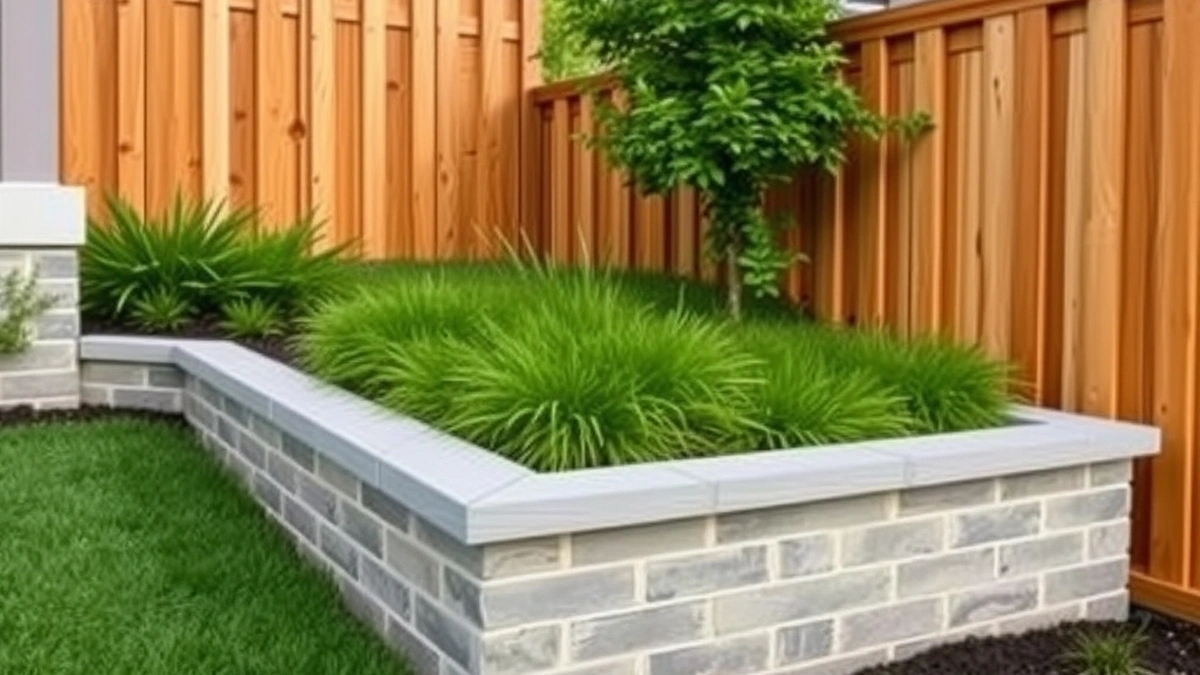
A fence marks a boundary and holds nothing but its own weight. A retaining wall holds soil at two elevations and must resist lateral earth pressure, which is why it needs a footing, drainage, and often a permit.
- Fence post depth
- 24–36 in
- Block wall cost
- $15–$35 per sq ft
- Timber wall cost
- $10–$25 per sq ft
- Drainage and backfill
- $5–$15 per sq ft
Some links on this page are affiliate links.If you buy through them we may earn a commission at no extra cost to you. We do not accept payment for rankings. Read the full disclosure.
A fence is a boundary marker and a privacy screen; a retaining wall is a structure that holds soil at two different levels. They are sometimes confused because both are vertical, linear, and built along a property line, but only one of them is designed to resist lateral earth pressure. Choosing between them is really a question of whether there is a grade change to hold.
The Definition That Settles the Question
A retaining wall is a structure built to resist the lateral pressure of soil so that ground on one side can sit higher than ground on the other. A fence is a barrier that encloses or divides space and carries only its own weight plus wind load. That is the entire distinction, and it decides everything downstream: foundation, drainage, permitting, and cost.
If the ground is level on both sides of the line, you need a fence. If one side is higher, you need a wall, a terrace, or a regrade — and a fence can sit on top of a properly designed wall, but never in place of one.
Why a Fence Cannot Do a Wall’s Job
A typical fence post is set 24 to 36 inches deep in a concrete collar. That depth exists to resist wind uplift and frost heave, and it is measured against a load of maybe a few hundred pounds at the top of an 8-foot panel.
A retaining wall at 4 feet resists much more. Using a soil unit weight of 110 pounds per cubic foot, 4 feet of height, and a coefficient of 0.3:
110 pounds per cubic foot × 4 feet × 0.3 = 132 pounds per square foot at the base.
Multiply that by the height to get the total lateral force per foot of wall length, and a 4-foot wall is carrying roughly 264 pounds of horizontal push for every linear foot. A fence post cannot develop that resistance, and a fence panel would simply rotate out of the ground.
Side-by-Side Comparison
| Feature | Fence | Retaining wall |
|---|---|---|
| Holds soil | No | Yes, by design |
| Foundation | Post holes 24–36 in | Leveling pad or footing, below frost line |
| Drainage required | No | Yes: drain core, pipe, outlet |
| Typical permit trigger | Zoning height limits | Height above 4 ft, or any surcharge |
| Installed cost | Estimated $25–$50 per linear ft | $10–$60 per sq ft of face |
| Service life | 15–20 years for wood | 25–100 years depending on material |
The cost columns are not directly comparable, which is the trap. A fence is priced per linear foot; a wall is priced per square foot of face, so a 4-foot wall costs four times its per-foot rate.
The Cost Arithmetic, Shown
Take a 100-foot property line.
For a 6-foot wood privacy fence at an estimated $30 per linear foot — fence pricing is regional, so treat this as an estimate:
100 linear feet × $30 = $3,000.
For a 4-foot block retaining wall along the same line, the face area is:
100 feet × 4 feet = 400 square feet.
At $25 per square foot:
400 square feet × $25 = $10,000.
Add drainage and backfill at $10 per square foot:
400 square feet × $10 = $4,000.
Total: $14,000. That is roughly 4.7 times the fence, and it buys a different product, not a fancier version of the same one.
When You Need Both
The common real-world case is a boundary wall that also carries a fence. The wall holds the grade change; the fence sits on the upper terrace and marks the line. That works, but the wall has to be designed for it. A fence adds wind load and an overturning moment at the top of the wall, and a wall sized only for soil can be pushed past its margin.
Two practical rules follow. First, tell the wall designer that a fence is going on top, and how tall it will be. Second, set fence posts in a separate foundation behind the wall face rather than coring into the cap units, so the posts do not split the blocks or create a water path into the backfill.
Cheaper Alternatives to a Full Wall
- Regrade instead of retain. If the slope is gentle, spreading it over more horizontal distance often costs less than any wall and needs no permit.
- Terrace in two low steps. Two 2-foot walls with a planted bench between them can be cheaper and more stable than one 4-foot wall, though they need more footprint.
- Use a planted slope with erosion control. Dense groundcover, jute netting, and a shallow toe wall can hold a low bank where a vertical face is not required.
- Build a low toe wall only. A 12-to-18-inch boulder or timber edge at the bottom of a slope often solves the erosion problem without retaining the whole bank.
Steps Before You Build Either One
- Measure the actual grade change at the steepest point, not the average.
- Check your local zoning code for fence height limits and setback from the property line.
- Call 811 before any digging, fence post or footing.
- Ask the building department whether your wall height triggers a permit or sealed drawings.
- Get the drainage design in writing before you compare wall bids.
If the grade change is real, price a wall properly using our retaining wall cost breakdown and read retaining wall drainage before you approve a scope. If the ground is flat, a fence is the correct and much cheaper answer, and no amount of wall budget will improve it.
One more distinction worth keeping straight: a fence is usually a permitted-by-right improvement subject only to height and setback rules, while a wall can trigger structural review. Before you hire anyone for the wall side, read finding a retaining wall contractor near you so the permit and inspection questions are settled before excavation.
Frequently asked questions
Can I build a fence on top of a retaining wall?
Yes, if the wall was designed for the extra load. A fence adds wind load and overturning moment to the wall, so a wall built only for soil may need a taller footing or a separate post foundation.
Is a fence cheaper than a retaining wall?
Yes, usually by a wide margin, because a fence carries no soil. A 100-foot privacy fence is commonly estimated in the low thousands, while a 4-foot block wall of the same length runs five figures.
Do I need a permit for a fence or a retaining wall?
Fence rules are usually local zoning limits on height and setbacks. Retaining walls often need a building permit above 4 feet, or at any height when they support a surcharge such as a driveway.
Can a fence hold back soil?
No. Fence posts are set 2 to 3 feet deep to resist wind and frost, not lateral earth pressure, and a fence panel has no design capacity to retain a soil wedge behind it.
What holds soil better, a wall or a terraced slope?
A terraced slope with planted risers can hold soil with less structural cost than a vertical wall, but it needs more horizontal space and permanent erosion control on each terrace.
Which lasts longer, a wood fence or a retaining wall?
A quality retaining wall usually outlasts a wood fence several times over. Block and concrete walls are commonly estimated at 50 years or more, while pressure-treated wood fencing is often replaced in 15 to 20.
Sources
Some links are affiliate links.If you buy through them we may earn a commission at no extra cost to you. We do not accept payment for rankings. Read the full disclosure.