Gabion vs Segmental block
Gabion vs Segmental block: practical numbers, costs, and trade-offs, written independently.
'Gabion vs Segmental block: practical numbers, costs, and trade-offs, written independently. The guide below shows the numbers and the trade-offs.'
- Typical range
- Varies by system and site
- First step
- Measure the space and confirm the load
- Professional help
- Recommended for structural or electrical work
Some links on this page are affiliate links.If you buy through them we may earn a commission at no extra cost to you. We do not accept payment for rankings. Read the full disclosure.
Gabion and segmental block both hold soil, and on installed cost gabion runs $20 to $40 per square foot against $15 to $35 for block. Block is cheaper on a dry, accessible site and gives a finished face. Gabion is the better buy on a wet slope, a tight site, or where stone is cheap and labor is not. Neither is a structural upgrade over the other; they fail in different ways.
What each wall is
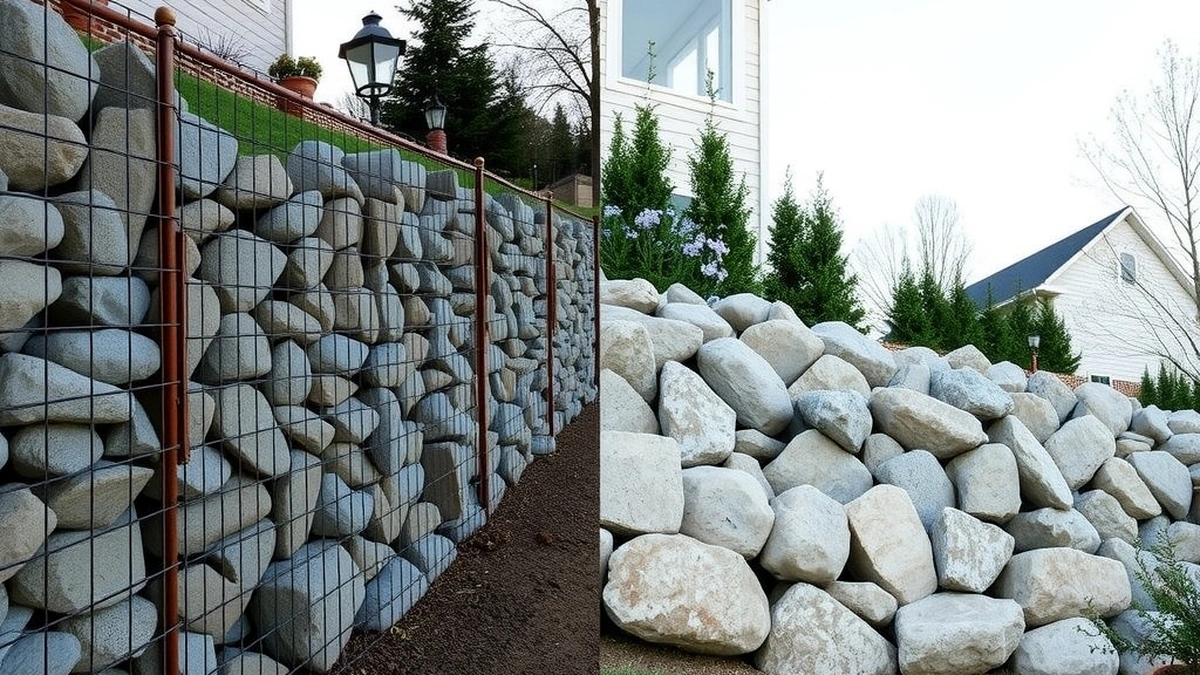
A gabion wall is a stack of wire mesh baskets filled with stone, tied together and stepped back slightly as it rises, so the mass of stone resists the soil behind it. A segmental block wall is a stack of interlocking concrete units on a compacted gravel base, often with geogrid layers, that works as a gravity or reinforced structure.
Neither uses mortar. Both need a proper base and a drainage path. The difference is what carries the load: stone mass in a basket, or engineered block units with a defined connection to the grid.
Cost per square foot, with arithmetic
The published installed rates are block at $15 to $35 per square foot, gabion at $20 to $40, boulder at $20 to $45, poured concrete at $25 to $60, timber at $10 to $25, and drainage and backfill at $5 to $15.
For a 40 ft wall at 4 ft high, the face is 40 × 4 = 160 sq ft. Gabion: 160 × $20 = $3,200 to 160 × $40 = $6,400. Block: 160 × $15 = $2,400 to 160 × $35 = $5,600. The gap is $800 at the low end and $800 at the high end, which is narrower than most homeowners expect.
Drainage and backfill at $5 to $15 per square foot adds 160 × $5 = $800 to 160 × $15 = $2,400. That line differs between the two systems, because a gabion wall needs less gravel but still needs geotextile, a compacted base, and excavation.
| System | Rate per sq ft | 160 sq ft wall |
|---|---|---|
| Timber | $10–$25 | $1,600–$4,000 |
| Segmental block | $15–$35 | $2,400–$5,600 |
| Gabion | $20–$40 | $3,200–$6,400 |
| Boulder | $20–$45 | $3,200–$7,200 |
| Poured concrete | $25–$60 | $4,000–$9,600 |
Gabion vs segmental block: the direct comparison
| Aspect | Gabion | Segmental block |
|---|---|---|
| Face finish | Coarse stone, visible mesh | Clean, uniform, walkable past |
| Installed rate | $20–$40 per sq ft | $15–$35 per sq ft |
| Drainage | Through the face | Gravel envelope and pipe |
| Repair | Cut and re-lace a basket | Remove and replace units |
| Best height | Low to moderate | Low to moderate, with grid above |
| Site fit | Wet, tight, irregular | Dry, accessible, visible |
The choice is not about strength. Both systems can be engineered for the same retained height, and both fail when the drainage or the base is wrong. It is about water, finish, and what the site allows.
Drainage: stone fill vs pipe and gravel
A gabion wall drains through its face. Water enters the basket, runs through the stone, and leaves. A block wall drains through a gravel envelope and a perforated pipe at the footing, because the block face is not permeable.
That difference has a cost consequence. A block wall needs the full detail — filter fabric, washed gravel, pipe, and a gravity outlet — and that is where the $5 to $15 per square foot goes. A gabion wall needs geotextile and a compacted base but less gravel, so the allowance is smaller. It is not zero. Geotextile still has to sit between the baskets and the soil to stop fines washing into the stone and clogging it.
Where each one fails
| Failure | What it looks like on gabion | What it looks like on block |
|---|---|---|
| Bulging | Baskets deform outward | Courses step out of line |
| Settlement | Bottom course sinks, ties slacken | Base course drops, joints open |
| Stone loss | Fill drains out of a torn basket | Not applicable |
| Grid or tie failure | Baskets separate at the corners | Geogrid pulls out of the block |
| Water damage | Fines clog the stone, wall turns into a dam | Gravel clogs, hydrostatic pressure builds |
The first three are installation problems. The last two are design and drainage problems, and they are the ones that take a wall down.
Which one fits your site
- Measure the height at both ends, from the bottom of the planned footing, and note the length.
- Check access. A gabion wall arrives as baskets and tons of stone, so a truck needs to get close or the labor line climbs.
- Check water. A spring, a downspout, or a wet season at the wall line favours gabion.
- Check the finish you want. A visible block face can be planted or left plain; a gabion face is stone and mesh.
- Price stone before you choose. Cheap local stone moves gabion toward the bottom of its range; delivered stone from 40 miles away moves it to the top.
- Confirm the permit threshold with the local building department before ordering either material.
The permit and engineering question
Most jurisdictions require a retaining wall permit at 3 or 4 ft of exposed height, and most require sealed engineering above 4 ft. A gabion wall is not exempt because it is flexible. The review looks at bearing, sliding, overturning, and drainage regardless of the material, and a wall carrying a driveway or a structure gets a structural review at any height.
That matters before you compare prices, because engineering and permit fees sit outside both installed rates. Budget them as separate lines.
What to price before you choose
Price the wall, the drainage, the excavation, the haul-off, the permit, and the engineering as five separate lines. A quote that folds them into one square-foot number hides the part that decides whether the project is affordable.
For the gabion budget in detail, see gabion wall cost and gabion cost. For the block side, see segmental block cost. For the build sequence, see gabion installation and segmental block installation.
Frequently asked questions
What is the most important measurement?
Start with the ceiling or clearance number; it decides which systems can fit.
What does a typical project cost?
Costs vary by system and site access; the guide shows the line items and a planning range.
Can I install this myself?
Some tasks are DIY-friendly, but structural, electrical, and load-bearing work should be done by a licensed professional.
How long does installation take?
A simple setup is a weekend; a full build with electrical or structural work can take several weeks.
What should I check before buying?
Confirm dimensions, load ratings, and the manufacturer's installation requirements for your exact model.
Where can I find local help?
Ask a licensed contractor or installer who has worked with the same system and can inspect your site.
Sources
Some links are affiliate links.If you buy through them we may earn a commission at no extra cost to you. We do not accept payment for rankings. Read the full disclosure.