Retaining Wall Failure: Modes, Signs, and What to Do
How retaining walls fail, from overturning and sliding to clogged drains and bad base prep, plus the signs that mean you should stop driving on it.
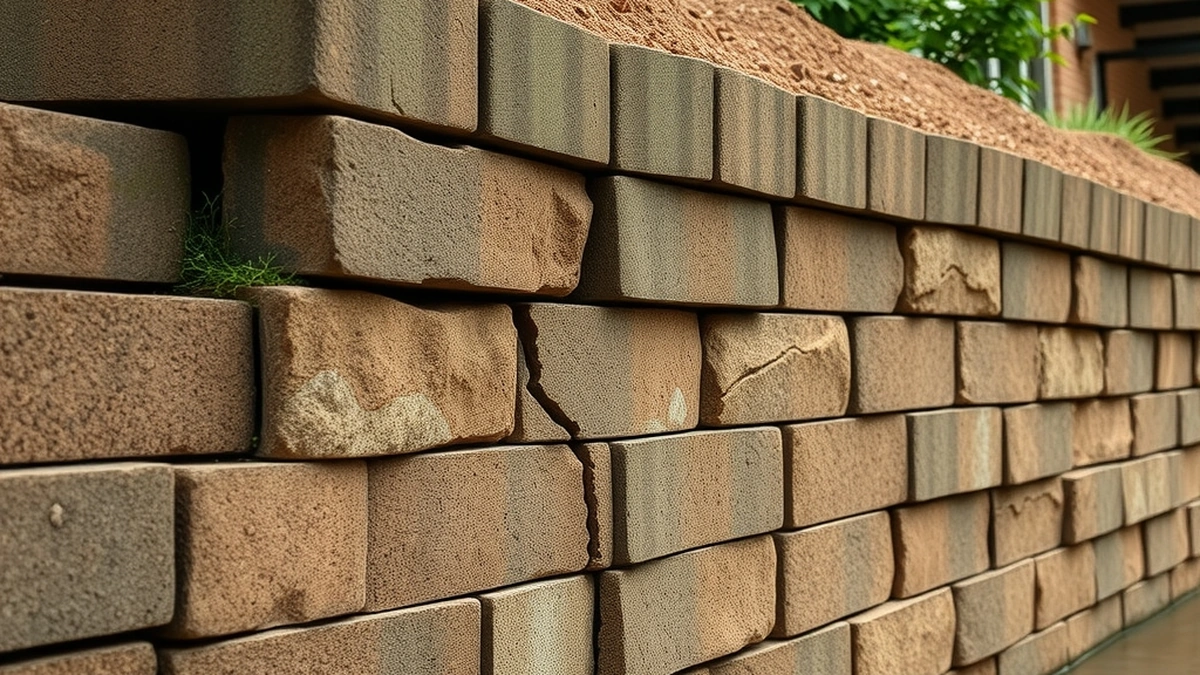
Retaining walls fail when pushing forces exceed what the soil, base, and reinforcement can resist. Water is the usual trigger: saturated backfill nearly doubles lateral pressure. Bulging, leaning, or stair-step cracks are the signs, and movement over 2 inches needs an engineer.
- Most common cause
- Water in the backfill
- Pressure at 6 ft, dry soil
- About 594 pounds per linear foot
- Pressure at 6 ft, saturated
- About 1,125 pounds per linear foot
- Structural movement
- More than 2 inches of bulge
- Drainage cost to prevent it
- $5 - $15 per square foot
Some links on this page are affiliate links.If you buy through them we may earn a commission at no extra cost to you. We do not accept payment for rankings. Read the full disclosure.
Retaining wall failure is any loss of the wall’s ability to hold soil at two elevations, whether that shows up as a lean, a bulge, a cracked face, or a collapse. Most failures trace back to water in the backfill, a base that could not carry the load, or reinforcement that was never installed. The wall does not usually fail all at once; it moves, cracks, and accelerates over one or two wet seasons.
The Four Structural Modes
Engineers test a wall against four separate failure modes, and a wall can pass three while failing the fourth.
| Mode | What happens | Typical sign |
|---|---|---|
| Overturning | The wall rotates forward around its toe | Top leans out, base stays put |
| Sliding | The whole wall pushes forward on its base | Vertical gap opens at the toe |
| Bearing | The soil under the base gives way | Wall drops and tilts as one piece |
| Global | The whole slope moves, wall included | Cracks in the ground behind the wall |
A wall that leans from the top is overturning. A wall that has moved forward bodily but stayed vertical is sliding. A wall that has sunk and rotated is a bearing failure. A wall where the ground behind it has cracked in a curve is part of a slope failure, and rebuilding the wall alone will not fix it.
Water Is the Usual Trigger
Dry soil at 110 pounds per cubic foot and an active pressure coefficient of 0.3 produces a lateral force of 594 pounds per linear foot at 6 feet:
½ × 0.3 × 110 × 6² = 594 lb per linear foot.
Saturate that same backfill and the unit weight rises toward 125 pounds per cubic foot while the coefficient climbs toward 0.5, because water pressure pushes equally in all directions:
½ × 0.5 × 125 × 6² = 1,125 lb per linear foot.
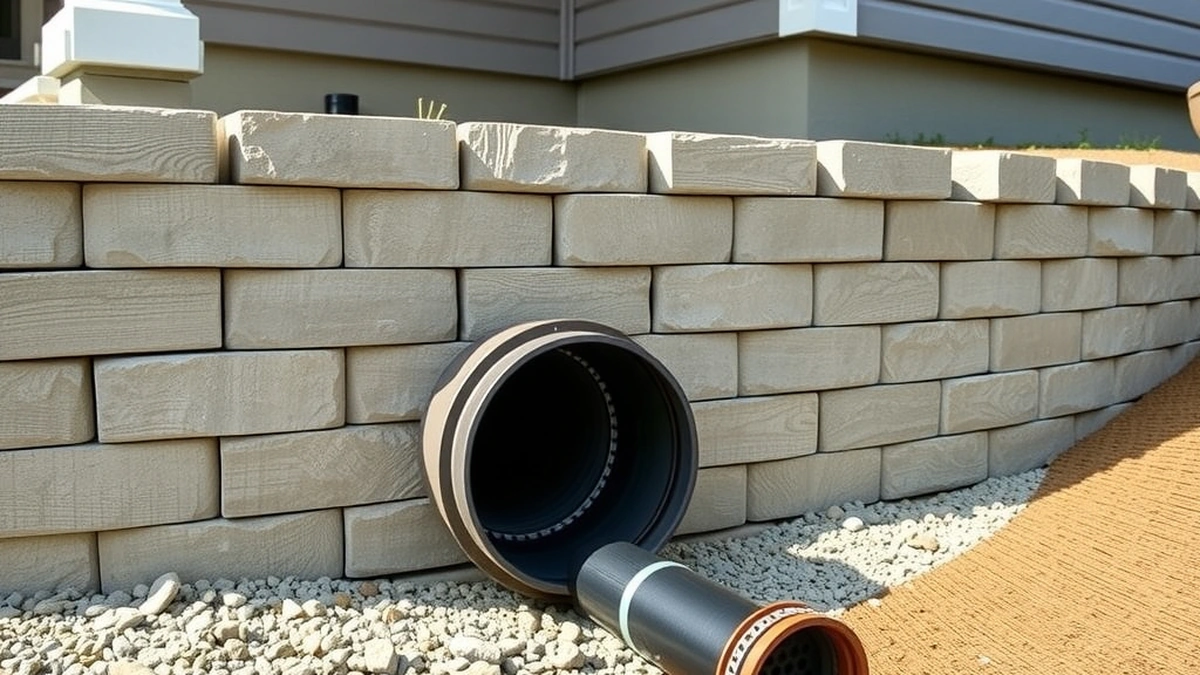
That is 1.9 times the dry load on a wall that did not change. This is why a drain clogged with sediment, a downspout redirected at the wall, or a gravel envelope that was never installed can take a wall from adequate to failing in a single storm. The drainage guide covers the detail that prevents it.
Soil, Base, and Foundation Problems
Clay holds water and expands, so it delivers both a higher unit weight and a higher pressure coefficient than sand or gravel. Expansive clay under a footing can lift one end of a wall in a dry season and drop it in a wet one, which is why the base has to bear on stable soil rather than on fill.
Poor compaction is the second foundation problem. Backfill placed in thick lifts and not compacted leaves voids that collapse later, and the wall above follows. A base trench that was dug to the wrong depth, or dug through topsoil into soft ground without removing it, produces the same result more slowly.
Construction Defects That Show Up Years Later
The defects that cause failure are rarely visible at handover. They are buried: geogrid that was specified but not installed, geogrid installed with too little embedment behind the failure plane, blocks stacked without the specified pin or lip engagement, drainage pipe wrapped in the wrong stone, or a wall built one course taller than the design allowed.
Block and material choice matters too. Block walls run $15 to $35 per square foot installed, and the lower end of that range often reflects a smaller unit or a shallower base. A block that is adequate at 3 feet is not automatically adequate at 5, even though it looks identical in the yard.
Reading the Signs
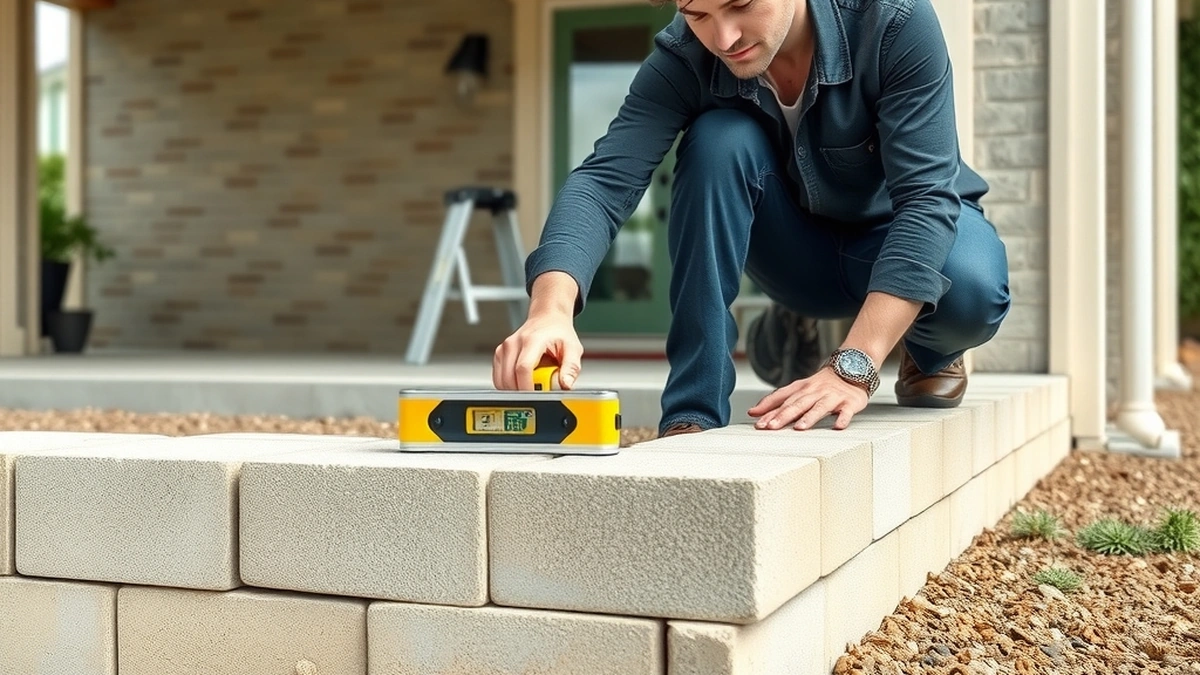
Check the wall the same way each time, so you can compare. Use a string line along the face, a level on the cap, and photographs with a date stamp.
- Lean. Hold a level against the face at three points. Any consistent tilt, or a tilt that has grown since the last check, is structural.
- Bulge. Stretch a string from one end of the wall to the other and measure the gap at the middle. A bulge over about 2 inches across a 10-foot run is a structural signal.
- Cracks. Stair-step cracks through block courses, horizontal cracks, and cracks that are wider at one end than the other all point to movement rather than shrinkage.
- Soil loss. Soil spilling through the face means the filter layer has failed and the backfill is washing out.
- Water. Look for wet patches at the toe, water pooling behind the wall, and stains below the weep holes.
- Settlement. A cap that has dropped relative to its neighbours, or a wall that has sunk at one end, indicates a base problem.
The bulging signs and settlement signs guides go deeper on each pattern.
What to Do When You See Movement
- Keep vehicles and heavy loads off the soil above the wall, and keep people away from the toe.
- Photograph and measure the movement, then note the date so you can tell slow from fast.
- Check that weep holes and the outlet pipe are open, and clear any obvious blockage without digging into the wall.
- Redirect downspouts, sump discharges, and surface drainage away from the backfill.
- Call an engineer for any wall above 4 feet, any wall carrying a structure or driveway, and any wall moving more than 2 inches.
- Do not jack, brace, or rebuild a section before the cause is diagnosed, because a repair that leaves the water path in place fails again.
A wall that is moving is also a temporary excavation hazard. Anyone working near the toe should follow the same cave-in protections used for any trench, which is where the OSHA excavation standard applies.
Repair or Replace
The decision follows the diagnosis. Drainage-only failures on a structurally sound wall are repairable, often for a fraction of a rebuild. Base rotation, corroded reinforcement, and bearing failures usually mean replacement, because the fix requires removing the wall to reach the problem.
A useful test is the cost ratio. If a proper repair bid comes in under 30 percent of replacement, repair is usually the right call. Above 60 percent, replacement is the better spend. The replacement cost guide shows what each material runs per square foot, and the support and geogrid guide explains the reinforcement that a rebuild should include.
Frequently asked questions
What is the first sign of a failing retaining wall?
A bulge or a lean that was not there before. Measure it against a string line stretched along the face. Movement of more than about 2 inches over a 10-foot run, or any tilt that grows between inspections, points to a structural problem rather than settling.
Can a retaining wall fail suddenly?
Yes, and the collapse is usually preceded by weeks of warning. Saturated soil after heavy rain, a blocked drain, or a new load on top of the wall can push a marginal wall past its capacity in hours. The visible signs are there first; the collapse is the last step.
Does a cracked retaining wall mean it has failed?
Not necessarily. Hairline cracks in mortar joints and shrinkage cracks in concrete are common and often cosmetic. Stair-step cracks that widen over time, horizontal cracks through block courses, and cracks paired with movement are the ones that indicate failure.
Who do I call for a failing retaining wall?
A geotechnical or structural engineer for anything above 4 feet, carrying a load, or showing real movement. A licensed retaining wall contractor can handle drainage and cosmetic repairs. Call the engineer first when the wall is leaning, because the repair sequence depends on the diagnosis.
Can I stop a wall from failing by adding drainage?
Drainage relief helps a wall that is still structurally sound, and it is the correct first move when water is the cause. It will not rescue a wall whose base has rotated or whose reinforcement has corroded. Those need a structural repair or a rebuild.
How long does a failing retaining wall last before it collapses?
There is no reliable timeline. A wall can sit at a 3-inch bulge for years and then move quickly in one wet season. Treat accelerating movement, new cracks, and soil spilling from the face as urgent and keep people and vehicles off the area above and below it.
Sources
Some links are affiliate links.If you buy through them we may earn a commission at no extra cost to you. We do not accept payment for rankings. Read the full disclosure.