Retaining wall drainage: the detail that decides
How retaining wall drainage works, the four parts of a drain system, hydrostatic load numbers, and what the detail costs per square foot.
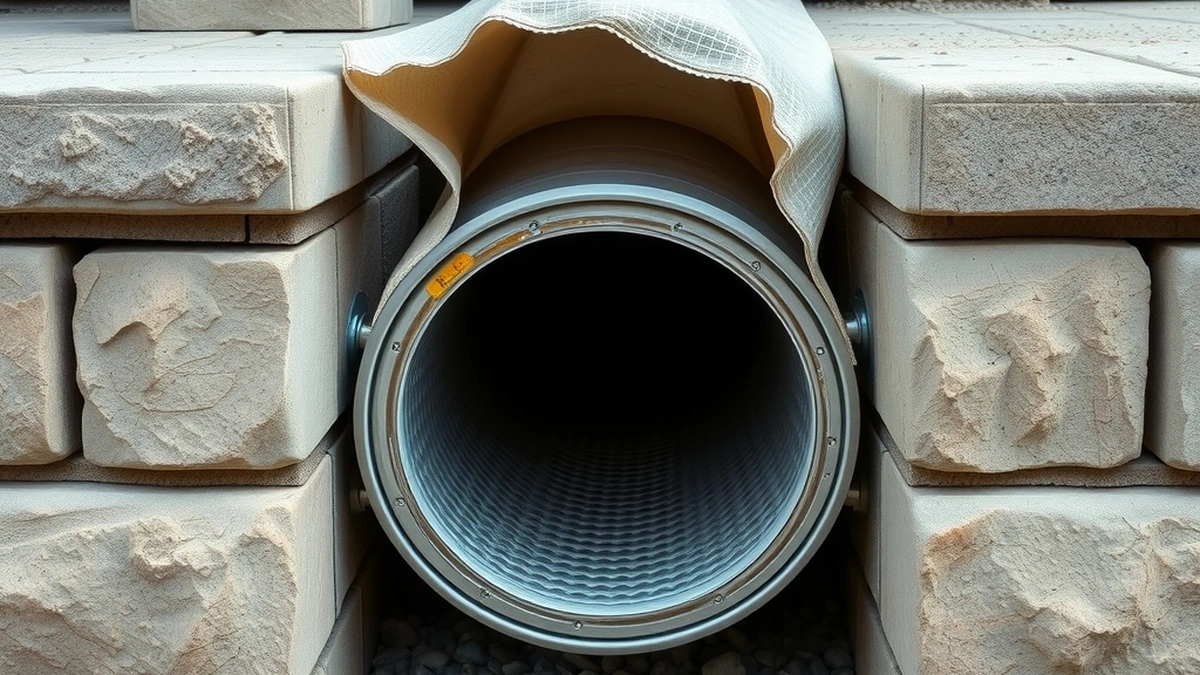
Retaining wall drainage is a gravel drain core, a perforated pipe at the base, filter fabric, and an outlet that daylights downhill. It removes water that would otherwise double the load on the wall.
- Water unit weight
- 62.4 lb/cu ft
- Drainage and backfill
- $5–$15 per sq ft
- Typical pipe diameter
- 4 in
- Gravel layer thickness
- 12 in min
Some links on this page are affiliate links.If you buy through them we may earn a commission at no extra cost to you. We do not accept payment for rankings. Read the full disclosure.
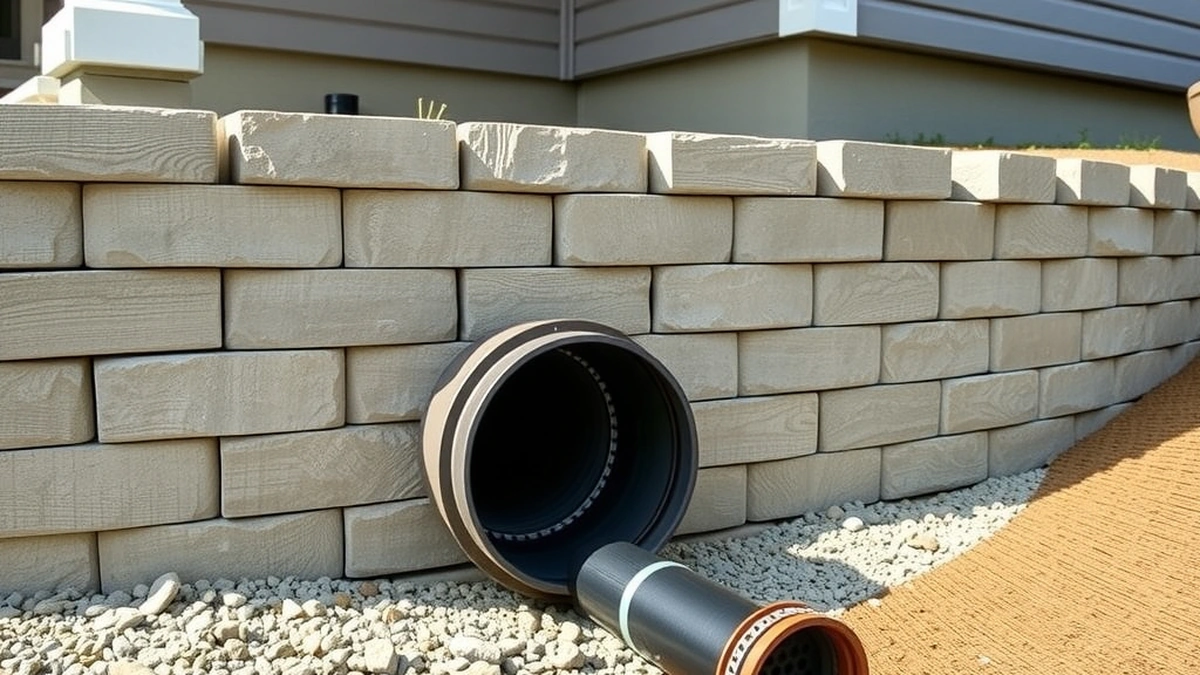
Retaining wall drainage is the gravel core, perforated pipe, filter fabric, and outlet that keep water from building up behind the wall. It is the single most important detail in the whole build, and it is the one most often left out of a cheap bid. A wall with perfect materials and no drainage is a wall on a timer.
What Drainage Actually Does
A retaining wall is a structure that holds soil at two elevations. When that soil is dry, its weight and internal friction are predictable. When it saturates, two things change at once: the soil gets heavier, and water pressure pushes directly on the wall.
Run the numbers for a 4-foot wall. Dry-ish soil, using 110 pounds per cubic foot and a coefficient of 0.3:
110 pounds per cubic foot × 4 feet × 0.3 = 132 pounds per square foot at the base.
Now the water alone, at 62.4 pounds per cubic foot:
62.4 pounds per cubic foot × 4 feet = 250 pounds per square foot at the same depth.
Water at full saturation pushes harder than the soil does. In practice the two combine, but the comparison makes the point: a saturated backfill can more than double the load a wall was designed to resist. Drainage is what keeps the design valid.
The Four Parts of a Drain System
The drain core. A layer of clean, free-draining crushed stone — usually 3/4-inch — placed between the wall and the retained soil, at least 12 inches thick. It gives water a path down instead of sideways into the wall.
The perforated pipe. A 4-inch perforated pipe at the base, sitting on the leveling pad behind the first course, with perforations facing down. It collects what the gravel delivers and carries it along the wall to an outlet.
The filter fabric. A geotextile between the gravel and the native soil. Without it, fines migrate into the gravel, the core clogs, and the drain becomes a dam.
The outlet. The point where the pipe discharges. It has to daylight downhill, or connect to a storm system, or run to a dry well. A pipe that ends in soil is not a drain.
Outlet choice matters more than it looks. Daylighting onto a slope is the simplest and most inspectable, but it can cause erosion at the discharge point unless you add riprap. A dry well works where the yard is flat, provided the soil percolates. A connection to a storm line is the cleanest but may require a permit and the utility’s approval. Whichever you choose, put it somewhere you can see it, because a buried outlet that clogs silently is the same as no outlet.
The Detail, Top to Bottom
- Grade the surface above the wall so it falls away at roughly 2 percent. Most water arrives from above, not from within.
- Place the pipe on the compacted base behind the first course, at about 1 percent slope toward the outlet, perforations down.
- Wrap the pipe and gravel in filter fabric, overlapping the seams so soil cannot enter the core.
- Fill the drain core with clean crushed stone as the courses rise, keeping the stone between the wall and the fabric.
- Backfill behind the fabric with compacted material, in lifts, so the wall is not carrying loose fill.
- Daylight the outlet at a location you can inspect, and protect it with a screen or riprap so it does not scour or clog.
Pipe, Weep Holes, and Drain Mat Compared
| Method | Where it works | Limitation |
|---|---|---|
| Perforated pipe in gravel core | Any wall with room behind the face | Needs a downhill outlet |
| Weep holes only | Short walls, older repairs | Clog easily, stain the face, low capacity |
| Drain mat / geocomposite | Tight sites with little room | Lower flow than a gravel core |
| Surface swale above wall | Diverting water before it arrives | Does not handle water already in the soil |
Most residential walls use the pipe and gravel core. Weep holes are a supplement, not a substitute, and a wall relying on them alone usually shows staining and efflorescence within a few years.
What the Detail Costs
Drainage and backfill run $5 to $15 per square foot of wall face. For a wall 30 feet long and 4 feet high:
30 feet × 4 feet = 120 square feet.
At $10 per square foot:
120 × $10 = $1,200.
Set that against the wall itself, block at $25 per square foot:
120 × $25 = $3,000.
Drainage is roughly 40 percent of the wall cost at this height, and it is the portion that determines whether the other 60 percent survives. On a taller wall, add a chimney drain or a drainage composite if space behind the face is tight.
Signs a Drain Has Failed
Look for a bulge that starts low and moves up, staining or white efflorescence on the face, water weeping through joints after rain, a soft or sunken strip in the ground behind the wall, and a drain outlet that runs clear in dry weather or not at all in wet weather. Any of these means water is finding another path.
A failed drain is usually repairable if the wall has not moved much. Once the face is out of line, the repair becomes structural. Our weeping face repair and bulging prevention guides cover the next steps, and retaining wall cost shows what a rebuild runs if the wall is past saving.
Frequently asked questions
Does a retaining wall need drainage?
Yes. Water behind a wall adds hydrostatic pressure and reduces soil friction, so a wall without drainage can fail even if it was built with the right material and a good base.
What is the best drain for a retaining wall?
A 12-inch gravel drain core of clean 3/4-inch crushed stone with a 4-inch perforated pipe at the base, wrapped in filter fabric, and an outlet that daylights downhill is the standard detail.
Where does the perforated pipe go?
It sits on the leveling pad behind the first course, sloping at roughly 1 percent toward the outlet, with the perforations facing down so water enters without carrying soil with it.
Do I need weep holes if I have a drain pipe?
Weep holes help in walls without a full drain core and in older walls, but a properly built wall with a gravel core and piped outlet does not strictly need them. Many builders install both.
How much does retaining wall drainage cost?
Drainage and backfill typically cost $5 to $15 per square foot of wall face. On a 120-square-foot wall that is $600 to $1,800, and it is not a place to cut.
What are the signs of a failed retaining wall drain?
Water or mud seeping from the face, efflorescence, a bulge starting near the middle of the wall, a soggy strip above the wall, and a dip in the surface behind it are all common signs.
Sources
Some links are affiliate links.If you buy through them we may earn a commission at no extra cost to you. We do not accept payment for rankings. Read the full disclosure.