Poured Concrete vs Timber: Retaining Wall Comparison
Compare poured concrete and timber retaining walls by cost, drainage, lifespan, and soil pressure for US residential projects.
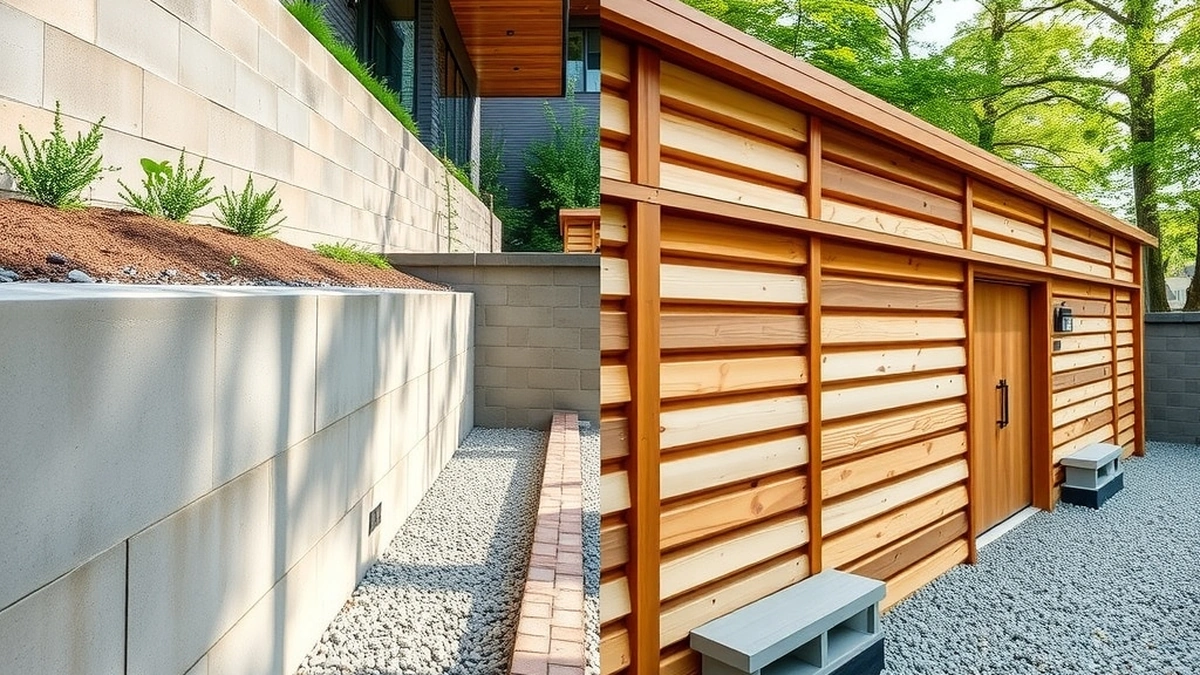
Poured concrete costs more upfront but lasts longer; timber costs less initially but requires replacement sooner. Drainage and backfill add $5–$15 per sq ft for either type.
- Poured concrete cost
- $25–$60 per sq ft
- Timber wall cost
- $10–$25 per sq ft
- Drainage and backfill
- $5–$15 per sq ft
- Typical concrete lifespan
- 30–50+ years
- Typical timber lifespan
- 15–25 years
Some links on this page are affiliate links.If you buy through them we may earn a commission at no extra cost to you. We do not accept payment for rankings. Read the full disclosure.
Poured concrete and timber are two common retaining wall materials, but they serve different budgets and timelines. Poured concrete costs $25–$60 per sq ft and typically lasts 30–50+ years. Timber costs $10–$25 per sq ft and typically lasts 15–25 years. Drainage and backfill add $5–$15 per sq ft to either option.
How Soil Pressure and Drainage Come First
Every retaining wall resists lateral soil pressure. The force increases with wall height and depends on soil type, slope, and water saturation. Water behind the wall is especially dangerous because it adds hydrostatic pressure and can push even a well-built wall outward.
Both poured concrete and timber walls need a drainage system. That usually means gravel backfill directly behind the wall, weep holes or drain outlets, and a perforated drain pipe at the base daylighting to a lower grade. Drainage and backfill add an estimated $5–$15 per sq ft. Skipping drainage to save money is false economy; water pressure is a leading cause of wall failure regardless of the facing material.
Before choosing a block, timber, or pour, confirm the wall height, setback requirements, and local code. Walls above a certain height often require engineering and a permit. For installation basics, see our guide on retaining wall installation.
Poured Concrete: Strength and Longevity
Poured concrete walls are formed on-site and cast as a single structural element. They resist soil pressure well and can be built taller than many timber systems without reinforcement issues. Concrete does not rot, and it is not vulnerable to termites.
The material and labor cost is $25–$60 per sq ft. For a 40 sq ft wall, that works out to $1,000–$2,400 for the wall face alone. Add drainage and backfill at $5–$15 per sq ft, or $200–$600 for the same 40 sq ft wall. Total estimated range: $1,200–$3,000.
Concrete performs well in wet climates because it does not absorb water like untreated wood. Cracks can still form from settlement or poor curing, but isolated cracks are often repairable. If you notice staining, seepage, or movement, review our retaining wall repair guidance before the problem spreads.
Timber: Lower Cost, Shorter Life
Timber retaining walls use pressure-treated landscape timbers, railroad ties, or heavy dimensional lumber stacked and pinned with rebar or spikes. They are common for garden beds, low terraces, and DIY-friendly projects under roughly 4 ft.
Timber costs $10–$25 per sq ft. For a 40 sq ft wall, the face costs $400–$1,000. Add drainage and backfill at $5–$15 per sq ft, or $200–$600. Total estimated range: $600–$1,600.
The tradeoff is durability. Pressure-treated timber resists rot and insects, but it is not permanent. Ground contact, moisture cycles, and fungal decay shorten its life. A typical timber wall lasts an estimated 15–25 years, depending on wood treatment, drainage quality, and climate. When timbers rot or pull away from the soil, the wall can lean or collapse. Ongoing care matters; see our retaining wall maintenance page for upkeep schedules.
Cost Comparison Table
The table below shows estimated material and labor costs for the wall face only. Drainage and backfill are listed separately because they apply to both types.
| Wall type | Wall face cost per sq ft | Drainage and backfill per sq ft | Estimated total per sq ft |
|---|---|---|---|
| Timber | $10–$25 | $5–$15 | $15–$40 |
| Poured concrete | $25–$60 | $5–$15 | $30–$75 |
For a 100 sq ft wall, timber might cost $1,500–$4,000 total with drainage, while poured concrete might cost $3,000–$7,500 total. These are estimates; actual quotes depend on site access, wall height, engineering needs, and local labor rates.
Load and Lifespan Arithmetic
Soil pressure grows with depth. A simple estimate for lateral pressure at the base of a wall is the equivalent fluid pressure method, where some soils exert roughly 30–60 pounds per square foot per foot of depth. For a 6 ft wall, that could mean roughly 180–360 pounds per square foot at the base before water is added. Saturated soil increases that figure substantially.
Poured concrete handles high base pressure because of its mass and monolithic shape. Timber walls resist pressure through the weight of the timbers, deadmen anchors, and tie-backs into the soil. As wall height increases, timber requires more robust anchoring and closer spacing.
Over a 50-year horizon, a poured concrete wall may need little more than crack monitoring and drainage checks. A timber wall in the same period may need partial or full replacement two or three times. The lower initial cost of timber can be offset by replacement labor and material costs within the lifespan of one concrete wall.
When to Choose Each Material
Choose poured concrete when you need a tall wall, poor drainage conditions, a long service life, or a structural face that supports a driveway or structure above. The higher cost buys durability and lower long-term maintenance.
Choose timber for low walls, garden terraces, tight budgets, or situations where the wall will be removed or relocated in 15–20 years. Timber is easier to modify on-site, but it demands vigilant drainage and regular inspection for rot.
If you are deciding between wall types more broadly, our best retaining wall overview compares concrete, timber, gabion, and boulder options. For cost context across materials, see retaining wall cost per square foot. If you want to understand how a wall differs from a fence for property boundaries, read retaining wall vs fence.
Maintenance and Repair Reality
No wall is maintenance-free. Inspect both types annually for bulging, leaning, separation at corners, and blocked drain outlets. Clear vegetation that can hold moisture against the face. Check that water exits the drain pipe during rain.
Concrete repairs usually involve epoxy injection for cracks or patching for surface spalling. Timber repairs mean replacing rotted timbers, which often requires excavating behind the wall to remove and install new members. If movement is significant, repair may not be enough; replacement with proper drainage and possibly engineered design is the safer path.
Bottom Line
Poured concrete vs timber comes down to upfront cost versus expected life. Timber costs $10–$25 per sq ft and lasts an estimated 15–25 years. Poured concrete costs $25–$60 per sq ft and lasts an estimated 30–50+ years. Both require drainage and backfill at $5–$15 per sq ft. Pick timber for short-term, low-height projects on a budget. Pick poured concrete when you want a permanent structure that resists soil pressure and water with minimal replacement cycles.
Frequently asked questions
Which wall costs less to build?
Timber walls cost $10–$25 per sq ft, while poured concrete runs $25–$60 per sq ft before drainage and backfill.
How much does drainage add?
Drainage and backfill add an estimated $5–$15 per sq ft to either wall type.
Which material lasts longer?
Properly built poured concrete typically lasts 30–50+ years; pressure-treated timber typically lasts 15–25 years.
Do both walls need drainage?
Yes. Water behind the wall creates hydrostatic pressure, so both need gravel backfill, weep holes, and a drain pipe.
Can I build either wall myself?
Small timber walls under roughly 4 ft may suit experienced DIYers; poured concrete usually requires professional forming and finishing.
When should I repair instead of replace?
Isolated cracks, leaning sections, or failing drainage often warrant repair rather than full replacement.
Sources
Some links are affiliate links.If you buy through them we may earn a commission at no extra cost to you. We do not accept payment for rankings. Read the full disclosure.