Wood Retaining Wall Cost: Timber, Ties, and Cedar
Wood retaining walls cost $10 to $25 per square foot installed. Treatment levels, post spacing, lifespan, and three worked budgets with drainage.
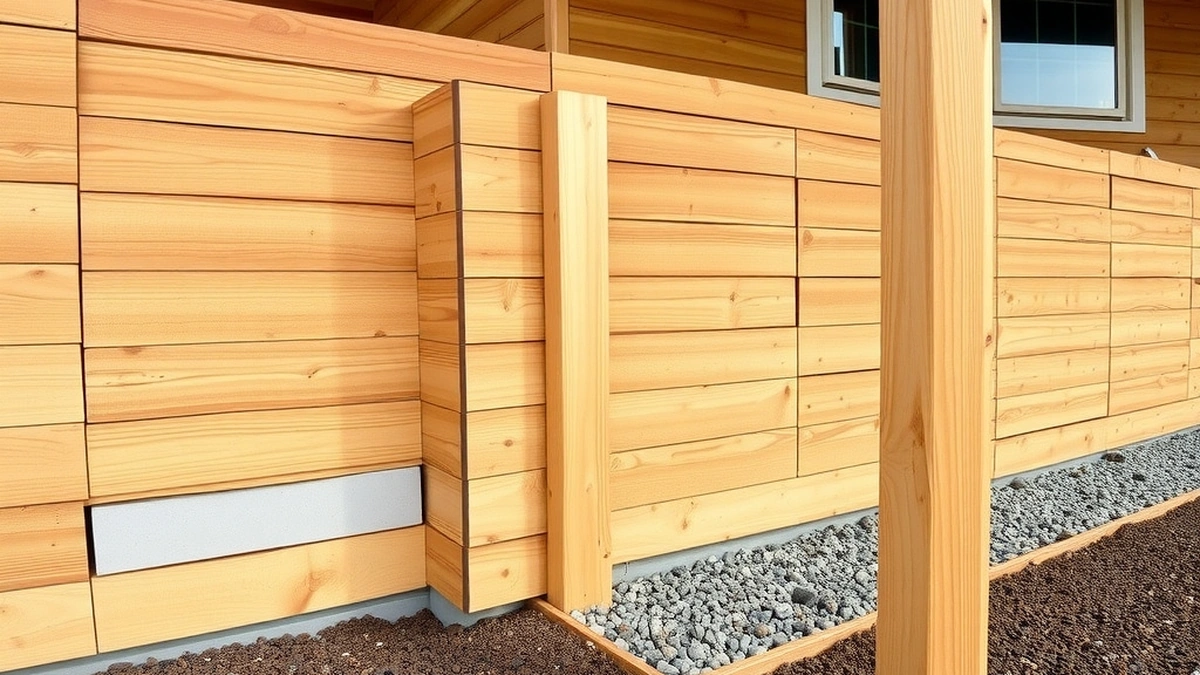
A wood retaining wall costs $10 to $25 per square foot of face installed, plus $5 to $15 for drainage gravel and pipe. Pressure-treated pine lands near the bottom of that range and cedar near the top. Expect 15 to 25 years, with the post at the soil line deciding how long.
- Timber wall, installed
- $10 - $25 per square foot
- Drainage and backfill
- $5 - $15 per square foot
- Typical service life
- 15 to 25 years
- Maximum common height
- 4 feet without engineering
- Typical 120 sq ft wall
- About $3,360
Some links on this page are affiliate links.If you buy through them we may earn a commission at no extra cost to you. We do not accept payment for rankings. Read the full disclosure.
Wood retaining wall cost is the price of the posts, the horizontal lagging, the fasteners, and the labor to set them, and it runs $10 to $25 per square foot of wall face installed. Drainage adds $5 to $15 per square foot. A 30-foot wall at 4 feet high is 120 square feet, which puts a typical pressure-treated job near $3,360 once drainage is included.
What the Price Covers
A timber wall is a post-and-panel structure. Vertical posts are embedded in the ground or anchored to a deadman behind the wall, and horizontal boards or timbers span between them to hold the soil. The cost splits into four parts:
Posts. Usually 4x4 or 6x6, set 2 to 4 feet deep depending on height and soil. Post spacing of 4 to 8 feet sets how many you need.
Lagging. 2x10 or 2x12 boards, or stacked 6x6 timbers. This is the visible face and the largest material line.
Fasteners and anchors. Galvanized or stainless lag screws, through-bolts, and deadman assemblies. Cheap hardware is the most common source of early failure.
Labor. Digging post holes, setting posts, cutting and fitting lagging, and compacting backfill.
The Three Wood Options
| Option | Installed rate | Expected life | Notes |
|---|---|---|---|
| Pressure-treated pine | $10–$18 per sq ft | 15–20 years | Ground-contact rated, most common |
| Cedar or cypress | $16–$25 per sq ft | 20–25 years | Naturally rot-resistant, fewer chemicals |
| Railroad ties | $12–$20 per sq ft | 10–20 years | Creosote restrictions apply in many areas |
Hardwoods such as ipe or black locust sit at or above the top of the range, and they are usually specified for a specific look rather than for budget. Whatever the species, the rating that matters is ground contact: lumber rated for above-ground use will rot at the soil line within a decade.
Cost by Height
Height changes the rate in two ways. Taller walls need deeper posts and thicker lagging, and they carry more soil pressure, so the safety margin comes from material rather than from labor.
| Wall height | Posts | Installed rate | Cost per linear foot |
|---|---|---|---|
| 2 ft | 4x4 at 6 ft spacing | $10–$15 per sq ft | $20–$30 |
| 3 ft | 4x4 at 6 ft spacing | $12–$18 per sq ft | $36–$54 |
| 4 ft | 6x6 at 6 ft spacing | $15–$25 per sq ft | $60–$100 |
| 5 ft and above | 6x6, engineered | Above the standard range | Design required |
The per-linear-foot column is simply the per-square-foot rate multiplied by the height. At 4 feet and $18 per square foot, 4 × $18 = $72 per linear foot.
Three Worked Budgets
Garden wall, 40 square feet. 2 feet high by 20 feet long.
Timber at $14: 40 × $14 = $560. Drainage at $8: 40 × $8 = $320. Total: $880.
Typical residential wall, 120 square feet. 4 feet high by 30 feet long.
Timber at $18: 120 × $18 = $2,160. Drainage at $10: 120 × $10 = $1,200. Total: $3,360.
Taller wall, 180 square feet. 6 feet high by 30 feet long.
This height needs engineering, so treat the rate as a planning estimate. Timber at $24: 180 × $24 = $4,320. Drainage at $12: 180 × $12 = $2,160. Total: $6,480, before design fees.
The third example is where timber loses its price advantage. A 6-foot timber wall needs a designed post embedment and often a deadman or geogrid, and the engineering cost lands on a wall that will still need replacement in 20 years.
Why Timber Is Cheap, and Where It Catches Up
Timber is cheap because the material is commodity lumber and the tools are a saw, a drill, and a level. There is no footing to pour, no crane to hire, and no block to deliver by the pallet. A two-person crew can build a low wall in two days.
The catch is service life. At 15 to 25 years, a timber wall built today will likely be replaced within the life of a mortgage. Using the 120-square-foot example, two builds at $3,360 each is $6,720 over 40 years, against one block wall at $15 to $35 per square foot, or $1,800 to $4,200, that lasts 50 years or more. That is not a reason to avoid timber; it is a reason to price it over the period you plan to stay.
Rot is concentrated at the soil line, where oxygen and moisture both exist. A post that is damp below grade and dry above decays at the transition, and the wall face follows as the post loses section. Ground-contact treatment and gravel drainage are what slow that process.
Wood Versus Block
| Factor | Timber | Segmental block |
|---|---|---|
| Installed cost | $10–$25 per sq ft | $15–$35 per sq ft |
| Service life | 15–25 years | 50+ years |
| Height limit without engineering | About 4 feet | About 4 feet |
| Repairability | Replace boards or a post | Reset individual blocks |
| Appearance | Natural, ages to grey | Manufactured, consistent |
| Fire and pest resistance | Low | High |
For a low garden wall the timber premium buys nothing structural, so the cheaper option is rational. For a wall that holds a driveway or a terrace, block is the better long-term spend. The timber versus block comparison works through the same trade-offs in more detail.
How to Read a Timber Bid
- Multiply wall length by height to get face area, then divide the bid by that number to compare per square foot.
- Confirm the post size, spacing, and embedment depth, since these are where cheap bids cut corners.
- Ask for the lumber treatment rating and species in writing, not just “pressure treated.”
- Check that the quote includes gravel, filter fabric, and a perforated drain, not just the wood.
- Confirm whether haul-off of excavated soil and disposal of old material are included.
- Ask for the permit line separately if the wall is at or above the local height threshold.
For the block alternative, see retaining wall blocks cost. For the drainage detail that decides how long either wall lasts, read retaining wall drainage, and for the full material range, retaining wall cost.
Frequently asked questions
How much does a wood retaining wall cost per square foot?
Between $10 and $25 per square foot of wall face installed, including material, posts, and labor. Add $5 to $15 per square foot for drainage gravel, filter fabric, and a perforated pipe. A 120-square-foot wall at $18 plus $10 drainage totals $3,360.
Is a wood retaining wall cheaper than block?
Yes on day one. Timber runs $10 to $25 per square foot against $15 to $35 for segmental block. Over 40 years the comparison reverses, because timber lasts 15 to 25 years and block lasts 50 or more, so timber may be replaced once or twice in the same span.
How long does a pressure-treated wood retaining wall last?
Fifteen to twenty-five years is the usual range, and the soil-line post is the limiting part. Wood that stays wet and lacks drainage fails at the bottom first. Ground-contact rated lumber and a gravel drainage layer push the life toward the top of the range.
Can I use railroad ties for a retaining wall?
Sometimes, but check the source. New ties are treated with creosote, which is restricted in many residential settings, and used ties may be contaminated or already rotten. Many jurisdictions limit tie walls to low heights, and some prohibit them near wells or waterways.
How tall can a wood retaining wall be?
Most prescriptive rules stop around 4 feet for a timber wall without engineering. Above that, the post embedment, lagging size, and deadman anchors need design, and a permit is almost always required. Do not scale a 4-foot detail up to 6 feet.
Does a wood wall need drainage behind it?
Yes, and it matters more than for block because wood rots. A gravel envelope with filter fabric and a perforated footing drain keeps the backfill from staying saturated. Without it, the wall carries full hydrostatic pressure and the posts decay from the wet side.
Sources
Some links are affiliate links.If you buy through them we may earn a commission at no extra cost to you. We do not accept payment for rankings. Read the full disclosure.