Timber vs Segmental Block Walls
Timber vs segmental block retaining walls compared on cost per square foot, service life, drainage, load capacity, and maintenance for US yards.
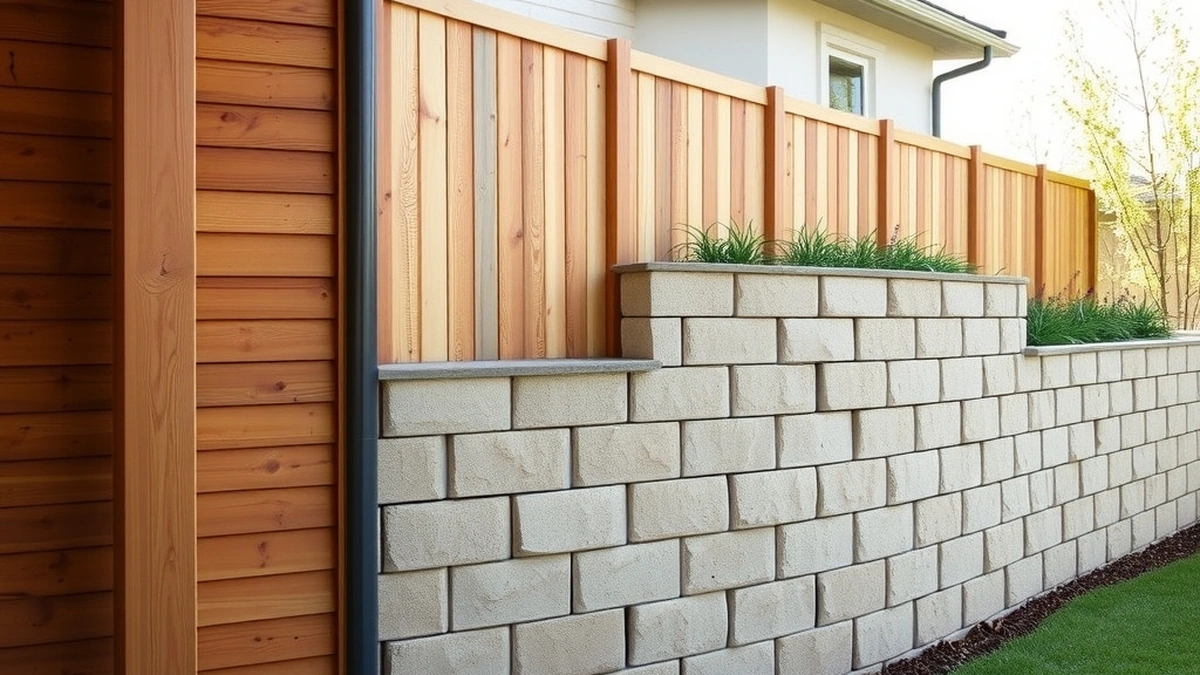
Timber costs $10 to $25 per square foot and lasts 15 to 25 years; segmental block costs $15 to $35 and lasts decades. Block wins on life and load, timber on first cost.
- Timber
- $10-$25 per sq ft
- Segmental block
- $15-$35 per sq ft
- Timber service life
- 15-25 years
- Drainage and backfill
- $5-$15 per sq ft
Some links on this page are affiliate links.If you buy through them we may earn a commission at no extra cost to you. We do not accept payment for rankings. Read the full disclosure.
Timber and segmental block are the two systems homeowners compare most often, because both are modular, both can be built by a competent crew in days, and both sit in the affordable half of the market. Timber runs $10 to $25 per square foot and segmental block runs $15 to $35, with $5 to $15 per square foot of drainage and backfill on either. The real difference is service life and how each system resists soil pressure.
What each system is
A timber retaining wall is a stack of pressure-treated horizontal members held by vertical posts and, on taller walls, deadmen that tie the face back into stable soil. It is a flexible structure that relies on embedment and tie-back rather than mass.
A segmental block wall is a dry-stacked system of interlocking concrete units set on a compacted gravel base, usually with geogrid layers extending into the retained soil at vertical intervals. The units and the reinforced soil act together as a gravity mass.
Neither is a retaining wall simply because it is tall and made of something heavy. Both depend on a base, a drainage path, and a tie-back or reinforcement design.
Cost, with the arithmetic
Take a 40 foot wall at 4 feet high: 40 × 4 = 160 square feet of face.
| System | Rate per sq ft | 160 sq ft | With drainage at $5-$15 |
|---|---|---|---|
| Timber | $10-$25 | $1,600-$4,000 | $2,400-$6,400 |
| Segmental block | $15-$35 | $2,400-$5,600 | $3,200-$8,000 |
Timber at the low end is 160 × $10 = $1,600; at the high end, 160 × $25 = $4,000. Segmental block is 160 × $15 = $2,400 to 160 × $35 = $5,600, with caps and geogrid at the top of the range. Drainage and backfill adds 160 × $5 = $800 to 160 × $15 = $2,400 to both.
So the first-cost gap on this wall is $800 at the low end and $1,600 at the high end. That is real money, but it is a one-time difference on a structure that will be compared over 20 years or more.
Service life and the second invoice
Timber’s weakness is that it is organic. Even ground-contact rated lumber sits in wet soil, and decay eventually wins at the ground line. Well-drained, properly treated timber commonly lasts 15 to 25 years. Timber against clay with no drain can fail in under 10.
Segmental block does not rot. Its service life depends on the base, the drainage, and whether the geogrid design matched the soil. Built correctly, a block wall can serve several decades with minimal work.
Run the numbers over 25 years. One timber wall at 160 square feet costs $2,400 to $6,400, and a replacement at the same rate is another $2,400 to $6,400, for $4,800 to $12,800 total. One block wall at $3,200 to $8,000 covers the same period. If the timber wall needs replacing once, block is the cheaper wall.
Soil pressure and reinforcement
Lateral earth pressure rises with the square of height, so a 4 foot wall carries about a quarter of the load of an 8 foot wall in the same soil. Both systems handle 4 feet comfortably when built properly; the difference appears as walls get taller or carry a surcharge.
Block distributes load through many small units and geogrid layers, which makes the reinforced soil mass the structure. That is efficient and predictable, and it is why block is the default choice for engineered residential walls above 4 feet.
Timber distributes load through posts and deadmen. It works, but the details are easier to skip: a post set 18 inches deep instead of 3 feet, or no deadmen at all, produces a wall that stands for a few seasons and then leans. If you build in timber above 4 feet, the design needs the same engineering attention as block.
Drainage behavior
Both systems need the same drainage package: clean gravel behind the face, filter fabric, a perforated pipe at the base, and an outlet that daylights downhill. At $5 to $15 per square foot, that package is the cheapest part of the project and the one that decides whether either wall survives.
Block is slightly more forgiving because water passes between units, so a partially blocked drain does not immediately saturate the backfill. Timber is unforgiving: water that cannot escape sits against the boards and pushes them outward, and the joints between boards are not designed to pass water.
In both cases, surface water is the bigger issue. Grade the ground above the wall away from the face and intercept uphill runoff with a swale. The detail is the same for either material and is covered in retaining wall drainage.
Appearance, curves, and resale
Timber reads as landscape. It suits planting beds, rustic yards, and short garden terraces, and it accepts stain in a range of tones. It also weathers, which some owners like and others do not.
Segmental block offers consistent color, tighter curves, and cap units that finish the top edge. It looks like built structure rather than garden edging, which suits patios, driveways, and formal plantings.
On resale, block tends to read as a permanent improvement and timber as a maintained one. That is a judgment, not a measurement, but it matches how buyers respond to a wall that is 12 years old in either material.
| Measure | Timber | Segmental block |
|---|---|---|
| Rate per sq ft | $10-$25 | $15-$35 |
| Service life | 15-25 years | Several decades |
| Rot risk | High if wet | None |
| Load capacity | Moderate, detail-dependent | High with geogrid |
| Routine work | Seal, re-fasten, replace boards | Clear drains, reset caps |
| Curve radius | Wide | Tight |
| Repair method | Cut out boards | Lift and rebuild units |
How to decide
- Measure the face as length × height, add 10 percent for cuts and steps, and price both systems at your square footage.
- Add $5 to $15 per square foot for drainage and backfill to each total, and confirm the quote includes it rather than listing it as an option.
- Decide how long you will own the property. Under 10 years, timber’s lower first cost usually wins; over 20, block usually does.
- Check the wall height against the local permit threshold, which is often 4 feet, and confirm whether a surcharge above the wall triggers engineering review.
- Look at the curve layout. If the wall needs a tight radius or a formal top edge, block is easier to detail.
- Ask what the wall will look like in 15 years. If the answer is “replaced”, budget for it now.
For material-level detail, see timber cost and block retaining wall cost. The annual work timber demands is set out in timber maintenance, and the failure symptoms that shorten its life are in timber problems. If you are weighing a third option, poured concrete vs segmental block covers the rigid end of the market.
Frequently asked questions
Is timber or segmental block cheaper for a retaining wall?
Timber is cheaper up front at $10 to $25 per square foot against $15 to $35 for segmental block, but the gap narrows over a 25 year period because timber usually needs replacing or major repair before block does.
How long does each wall last?
Pressure-treated timber in drained soil commonly reaches 15 to 25 years, while segmental block walls often serve several decades. Neglected timber in wet clay can fail in under 10 years.
Which wall is stronger against soil pressure?
Segmental block, when it is built with the geogrid the design calls for. Block units and grid create a reinforced soil mass, while timber relies on post embedment and deadmen that are easier to under-build.
Which is easier to repair, timber or block?
Both are repairable, but in different ways. Timber boards can be cut out and replaced individually, while block units can be lifted and the run rebuilt, which is cleaner but requires re-setting the base.
Does timber or block need more maintenance?
Timber needs more routine work: inspection, re-sealing every two to three years, and re-fastening. Block generally needs drain clearing and occasional re-levelling of caps, with no sealing.
Which wall looks better in a landscape?
It depends on the setting. Timber reads as garden structure and suits planting beds and rustic yards, while block offers consistent color and texture and can be curved tightly, which suits patios and formal landscaping.
Sources
Some links are affiliate links.If you buy through them we may earn a commission at no extra cost to you. We do not accept payment for rankings. Read the full disclosure.