Retaining wall cost: what a project really runs
Retaining wall cost by material, three worked budgets at different sizes, and the permit, excavation, and engineering costs around the wall.
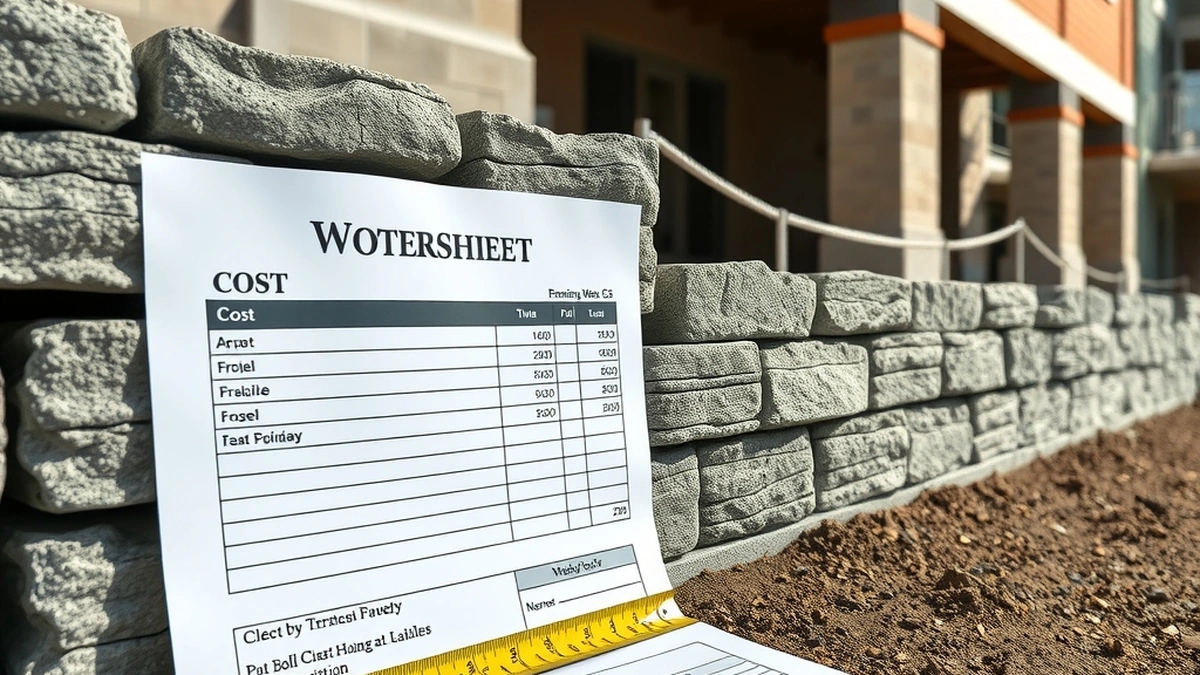
Retaining walls cost $10 to $60 per square foot installed depending on material, plus $5 to $15 per square foot for drainage and backfill. A typical 4-foot residential wall lands near $4,000 for 120 square feet.
- Timber wall cost
- $10–$25 per sq ft
- Block wall cost
- $15–$35 per sq ft
- Poured concrete cost
- $25–$60 per sq ft
- Drainage and backfill
- $5–$15 per sq ft
Some links on this page are affiliate links.If you buy through them we may earn a commission at no extra cost to you. We do not accept payment for rankings. Read the full disclosure.
A retaining wall costs $10 to $60 per square foot of wall face installed, and drainage and backfill add $5 to $15 on top. That range is wide because material, height, and site access all move the number, and because the cheapest bids often leave out the drainage line entirely. Here is what actually sets the price.
What the Price Is Made Of
A retaining wall is a structure that holds soil at two elevations, so its cost is driven by how much soil it holds and how hard the site makes the work. Four things dominate:
Face area. Height times length. This is the base quantity every material rate multiplies against.
Material. Block, timber, boulder, gabion, and concrete sit at very different price points.
Height. Load rises with the square of height, so a tall wall needs more base width, more reinforcement, and often engineering.
Site conditions. Access, slope, soil, rock, utilities, and haul distance can swing a bid by thousands before a single block is laid.
Cost by Material
Rates are per square foot of wall face, installed, including material and labor.
| Material | Installed cost | Service life estimate | Notes |
|---|---|---|---|
| Timber | $10–$25 | 15–25 years | Cheapest; rots at the soil line |
| Segmental block | $15–$35 | 50+ years | Best all-round residential choice |
| Gabion | $20–$40 | 25–50 years | Drains through the face |
| Boulder | $20–$45 | 75+ years | Needs machine access |
| Poured concrete | $25–$60 | 50–100 years | Forms, rebar, and a footing |
Add drainage and backfill at $5 to $15 per square foot of face to every row.
Three Worked Budgets
Small garden wall: 20 ft long, 2 ft high.
20 × 2 = 40 square feet.
Block at $25: 40 × $25 = $1,000. Drainage at $10: 40 × $10 = $400. Total: $1,400.
Typical residential wall: 30 ft long, 4 ft high.
30 × 4 = 120 square feet.
Block at $25: 120 × $25 = $3,000. Drainage at $10: 120 × $10 = $1,200. Total: $4,200.
Larger terraced wall: 50 ft long, 6 ft high.
50 × 6 = 300 square feet.
At a higher unit rate for height — say $35 per square foot, because geogrid and a wider base are likely — 300 × $35 = $10,500. Drainage at $12: 300 × $12 = $3,600. Total: $14,100, before engineering.
The jump from the 4-foot to the 6-foot example is not just more area. It is a higher rate per square foot, which is the point most budgets miss.
The same thing happens at the bottom of the range. A 2-foot wall is often priced at a higher rate per square foot than a 3-foot wall, because mobilization, delivery, and base preparation do not shrink with the wall. Small jobs carry a fixed cost that the face area cannot dilute, which is why the smallest walls look expensive on a unit basis.
The Costs Around the Wall
| Item | Typical treatment | Effect on budget |
|---|---|---|
| Permit | Usually $100–$500, varies by jurisdiction | Required above common height thresholds |
| Engineering | Sealed drawings for tall or loaded walls | Often $500–$2,000 |
| Excavation and haul-off | Bid by volume or truckload | Large on tight or sloped sites |
| Rock removal | Change order | Can exceed the wall cost |
| Utility relocation | Separate trade | Rare but expensive |
| Landscaping and paving | Separate scope | Often 30–50 percent of the total project |
If your total project budget is the wall plus the patio and plantings, plan for the wall to be roughly half of it.
Why Height Changes the Math
Using 110 pounds per cubic foot of soil and a coefficient of 0.3, base pressure at 3 feet is:
110 × 3 × 0.3 = 99 pounds per square foot.
At 6 feet:
110 × 6 × 0.3 = 198 pounds per square foot.
Base pressure doubles while height doubles, but total overturning force per foot of wall grows about four times, because the pressure triangle gets taller and wider at once. That is why the per-square-foot rate climbs with height rather than staying flat.
How to Build a Budget, In Order
- Measure length and height at the tallest point, and multiply to get face area.
- Pick two candidate materials and apply their rates, rather than averaging all five.
- Add drainage at $5 to $15 per square foot, always, as a separate line.
- Add permit and engineering if the wall exceeds your local threshold or carries a load.
- Add 15 percent contingency for rock, soft soil, or access problems, which are common and rarely discovered until excavation.
Reading Bids Against the Budget
When the quotes arrive, convert each one to a cost per square foot of face before comparing. Divide the total by the face area you measured. A bid at $3,900 for 120 square feet is $32.50 per square foot, which is high for block and low for concrete — and that tells you what the contractor assumed before you read a single line item.
Then check what the rate includes. Ask each bidder to confirm, in writing, whether excavation, haul-off, base stone, compaction, drainage, caps, permit, and cleanup are inside the number. The differences between bids are almost always in that list rather than in the block price.
Where to Save and Where Not To
Save on material where the look allows it, on length by terracing in two steps, and on scheduling by building in the slower season. Do not save on drainage, compaction, or base preparation. Those three items are the difference between a wall that lasts 50 years and one that needs rebuilding in eight. The arithmetic on a rebuild is the same as the original price, which makes cutting drainage a false economy at any discount.
For the labor side of these numbers, see retaining wall installation cost. For material-specific pricing, read concrete retaining wall cost and block retaining wall cost.
Frequently asked questions
How much does a retaining wall cost?
Between $10 and $60 per square foot of wall face installed, depending on material, plus $5 to $15 per square foot for drainage and backfill. Timber is cheapest and poured concrete is most expensive.
How much does a 4-foot retaining wall cost?
A 30-foot-long, 4-foot-high wall is 120 square feet. At $25 per square foot for block plus $10 for drainage, that is $3,000 plus $1,200, or about $4,200 before permits.
Is retaining wall cost priced per square foot or per linear foot?
Professional bids are usually priced per square foot of wall face, which lets the same rate apply at any height. Homeowners often compare per linear foot, which hides the height difference.
What is not included in a per-square-foot retaining wall price?
Permits, engineering, major excavation, rock removal, utility relocation, soil haul-off, and landscaping are usually excluded and can add several thousand dollars on a difficult site.
Why do taller walls cost so much more?
Load rises with the square of height, so a 6-foot wall resists roughly twice the force of a 3-foot wall and may need geogrid, a wider base, or engineering, all of which raise the unit price.
Can I reduce retaining wall cost without weakening it?
Yes, by shortening the wall, terracing into two lower walls, choosing block over poured concrete, keeping machine access open, and scheduling in the slower season. Never cut drainage.
Sources
Some links are affiliate links.If you buy through them we may earn a commission at no extra cost to you. We do not accept payment for rankings. Read the full disclosure.