Boulder Cost per Square Foot and per Ton
Boulder cost per square foot and per ton, how machine access and haul distance change the price, and how to budget a US rock wall.
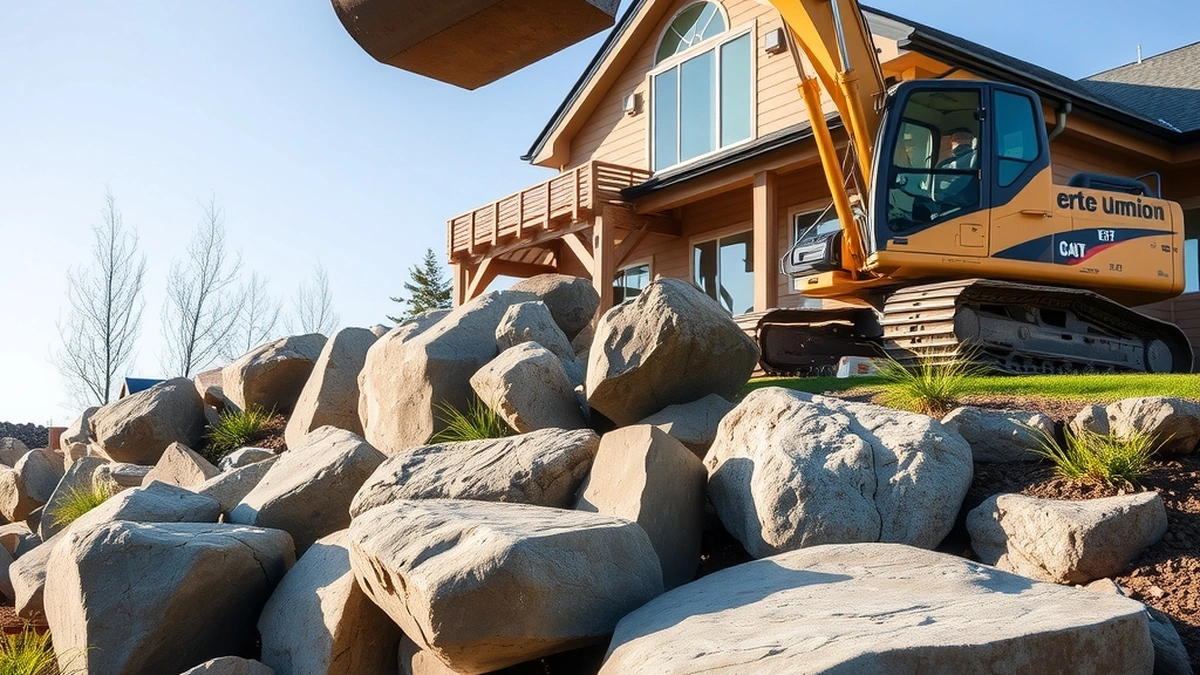
Boulder walls cost $20 to $45 per square foot installed, or $120 to $350 per ton for the stone. A 160 square foot wall runs $3,200 to $7,200, with access driving the spread.
- Installed rate
- $20-$45 per sq ft
- Stone price
- $120-$350 per ton
- 160 sq ft wall
- $3,200-$7,200
- Key variable
- Machine access
Some links on this page are affiliate links.If you buy through them we may earn a commission at no extra cost to you. We do not accept payment for rankings. Read the full disclosure.
Boulder retaining walls cost $20 to $45 per square foot installed, which puts them in the same band as gabion and above segmental block. The stone itself is usually $120 to $350 per ton delivered, and machine time is the other large line item. A 40 foot wall at 4 feet high, or 160 square feet, comes to $3,200 to $7,200, and the spread is mostly about how far the rock travels and whether an excavator can reach the wall line.
What a boulder wall is
A boulder retaining wall is a gravity wall built from large natural stone, set on a compacted base and battered back so each course leans into the slope. It relies on the mass of the stone and the friction between the pieces, not on mortar, geogrid, or a concrete footing.
Because the joints between boulders are open, the wall drains. That makes it a good fit for slopes with seepage and for landscapes where a natural stone face is wanted. It also means the stone must be heavy enough and set deep enough that water cannot move it.
Installed cost, with the arithmetic
Take a 40 foot wall at 4 feet high: 40 × 4 = 160 square feet of face.
| System | Rate per sq ft | 160 sq ft wall |
|---|---|---|
| Timber | $10-$25 | $1,600-$4,000 |
| Segmental block | $15-$35 | $2,400-$5,600 |
| Gabion | $20-$40 | $3,200-$6,400 |
| Boulder | $20-$45 | $3,200-$7,200 |
| Poured concrete | $25-$60 | $4,000-$9,600 |
Boulder at the low end is 160 × $20 = $3,200; at the high end, 160 × $45 = $7,200. The low end assumes local stone, good access, and a wall under 4 feet. The high end assumes imported stone, tight access, and a wall that needs a machine working at reach all day.
Those are installed planning estimates, not bids. The wider comparison across materials is in retaining wall cost per square foot.
Tonnage, worked out
Stone is bought by weight, so the square foot rate has to be converted to tons before you can check a quote.
A rough planning figure for a battered boulder wall is 0.25 to 0.35 tons per square foot of face. For 160 square feet: 160 × 0.25 = 40 tons at the low end, and 160 × 0.35 = 56 tons at the high end.
At $120 per ton delivered, 40 × $120 = $4,800. At $350 per ton, 56 × $350 = $19,600, which is why the high end of the stone range does not fit inside a $45 per square foot wall. In practice, expensive stone means a smaller wall or a different material.
That arithmetic is the single most useful check on a boulder quote. If a contractor quotes $3,500 for a 160 square foot wall and the stone alone prices out at $6,000, something in the quote is not what it appears to be, usually the stone size or the wall depth.
What drives the price
Stone size is the first driver. Boulders in the 1 to 2 ton range cost more per ton than 200 to 500 pound stones, but they also build a wall faster because fewer pieces are needed per square foot. Large stone can be cheaper overall on a tall wall.
Haul distance is the second. Rock is heavy and local quarries are not everywhere, so a 45 minute drive each way adds real cost per ton. Ask for the quarry name and the delivered price per ton, not a lump sum.
Wall depth and batter are the third. A boulder wall is typically half to two thirds as deep as it is tall, and a deeper wall uses more stone per square foot of face. A wall built with a pronounced batter needs more stone than a near-vertical one, and it also stands better.
Machine time and access
Boulders are set with an excavator, and the machine’s reach defines what the job costs. If the excavator can sit beside the wall line, placement is quick. If it has to work from the top of a slope, or from a driveway 60 feet away, every stone travels further and the job slows.
Ask two questions of any quote: what size machine is priced in, and where will it sit. A quote that assumes a machine can reach the wall when it cannot will grow once the work starts.
Small jobs sometimes use a mini excavator with a thumb, which is slower per stone but can get through a gate. That trade-off is worth pricing both ways on a rear-yard wall.
Drainage, base, and what is still needed
The wall drains through its joints, but it still needs a compacted gravel base, geotextile behind the stone to keep soil from washing into the voids, and backfill compacted in lifts. Budget a drainage and backfill allowance of $5 to $15 per square foot, or 160 × $5 = $800 to 160 × $15 = $2,400 on the example wall.
Some of that may already sit inside the installed rate. The point is to confirm which, in writing, rather than assume the number covers fabric and base.
How to budget a boulder wall
- Measure the face as length × height, add 10 percent for steps and curves, and multiply by $20 to $45 for the installed range.
- Convert to tonnage at 0.25 to 0.35 tons per square foot, then price that tonnage at your local delivered rate.
- Call two quarries for delivered prices and ask what stone sizes they stock, since size affects both price and build speed.
- Ask each contractor where the machine will sit and what size machine is in the quote.
- Confirm the quote includes excavation, base compaction, geotextile, and spoil removal.
- Compare the total against block and gabion on the same square footage before committing.
Where boulder wins and loses
Boulder wins on visual character, on sites with local stone, and on walls where a natural face suits the landscape. It also wins on seepage sites, where the open joints drain freely.
It loses on cost when stone must be hauled far, on tight sites where a machine cannot reach, and on walls that need a precise top edge or a flat face to plant against. It also loses on very tall walls, where the stone sizes needed push the price above block or concrete.
For the failure modes to watch during construction, see boulder problems, and for how owners judge finished walls, see boulder reviews. The material comparison is in segmental block vs boulder, and general pricing context is in retaining wall cost.
Frequently asked questions
How much does a boulder retaining wall cost per square foot?
Installed boulder walls typically run $20 to $45 per square foot of wall face, which includes the stone, delivery, base preparation, geotextile, and machine time for placing the boulders.
Is a boulder wall cheaper than segmental block?
Usually not. Boulder runs $20 to $45 per square foot against $15 to $35 for segmental block, so block is generally cheaper unless boulders are available locally and the site has machine access.
How many tons of boulder do I need for a wall?
A rough planning figure is 0.25 to 0.35 tons per square foot of wall face, so a 160 square foot wall needs about 40 to 56 tons. That is an estimate; the actual figure depends on stone size, wall batter, and how tightly the boulders nest.
Why does site access change the price so much?
Boulders are placed with an excavator, and if the machine cannot reach the wall line, the stone must be moved by hand or with a smaller machine. That can double the labor share of the quote.
Do boulder walls need drainage and backfill?
Yes, though less gravel than a solid wall because the joints between boulders pass water. They still need a compacted base, geotextile against the soil, and backfill, which is why a $5 to $15 per square foot allowance still applies.
Can I build a boulder wall myself?
Only at low height and with small stone. Boulders weighing several hundred pounds each require an excavator and a practised operator, and a wall above 4 feet should be designed and built by a professional.
Sources
Some links are affiliate links.If you buy through them we may earn a commission at no extra cost to you. We do not accept payment for rankings. Read the full disclosure.