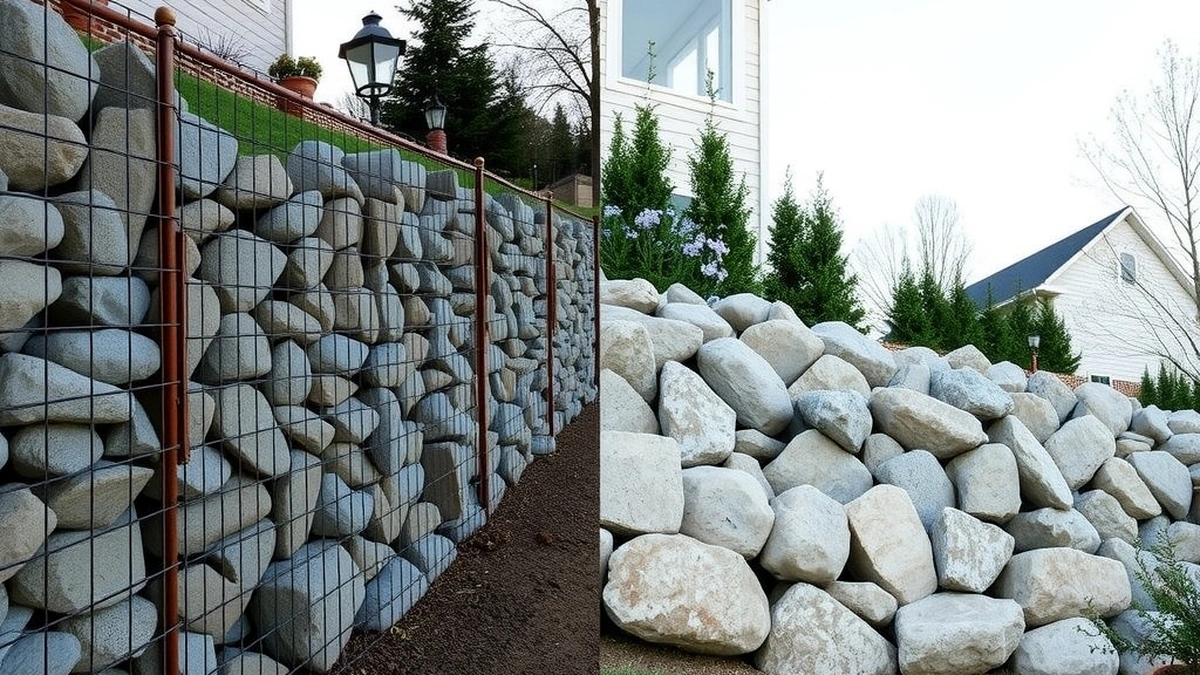
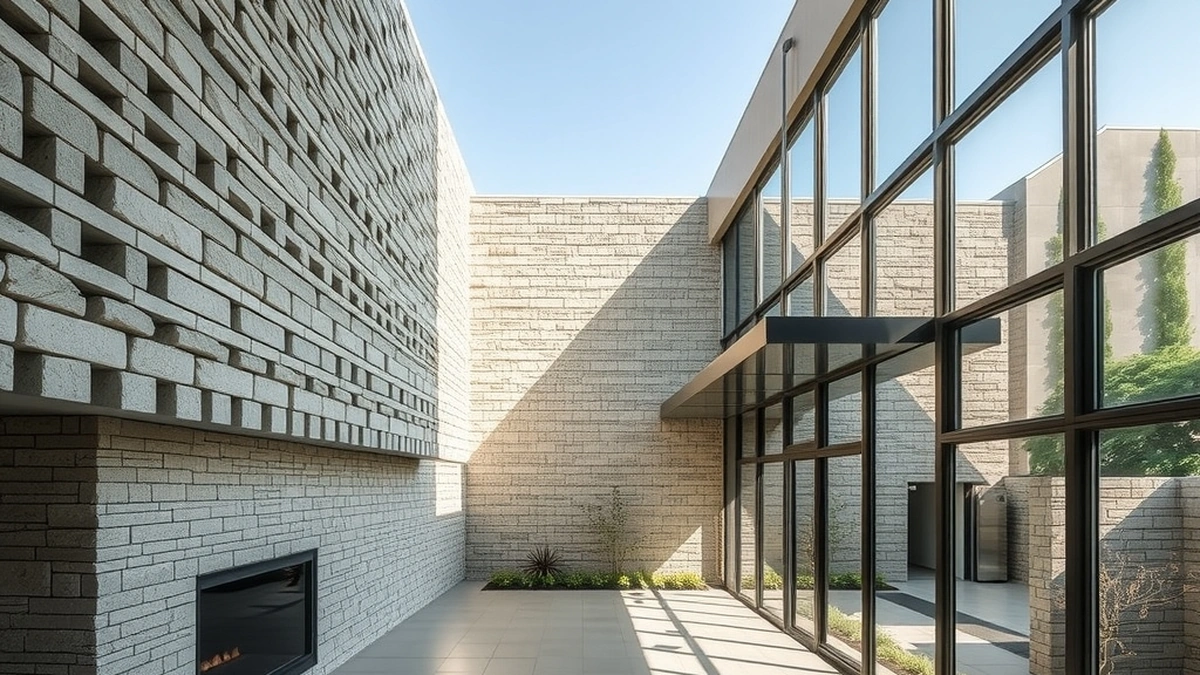
Poured Concrete vs Segmental Block
Poured concrete vs segmental block: cost per square foot, soil pressure, drainage, build time, and repairability compared for US retaining walls.
Poured concrete runs $25 to $60 per square foot and segmental block $15 to $35, before $5 to $15 for drainage. Concrete wins on strength and a narrow footprint; block wins on cost, drainage, and repairs.
- Poured concrete
- $25-$60 per sq ft
- Segmental block
- $15-$35 per sq ft
- Drainage and backfill
- $5-$15 per sq ft
- Key difference
- Rigid mass vs flexible units
Some links on this page are affiliate links.If you buy through them we may earn a commission at no extra cost to you. We do not accept payment for rankings. Read the full disclosure.
Poured concrete and segmental block are the two retaining wall systems most often specified for US residential work, and the choice usually comes down to water and movement rather than looks. Poured concrete costs $25 to $60 per square foot and works as one rigid mass; segmental block costs $15 to $35 per square foot and works as hundreds of small units that drain, settle, and can be replaced individually. Both need drainage behind them, and both need engineering review once the wall passes the local permit threshold.
What each wall is
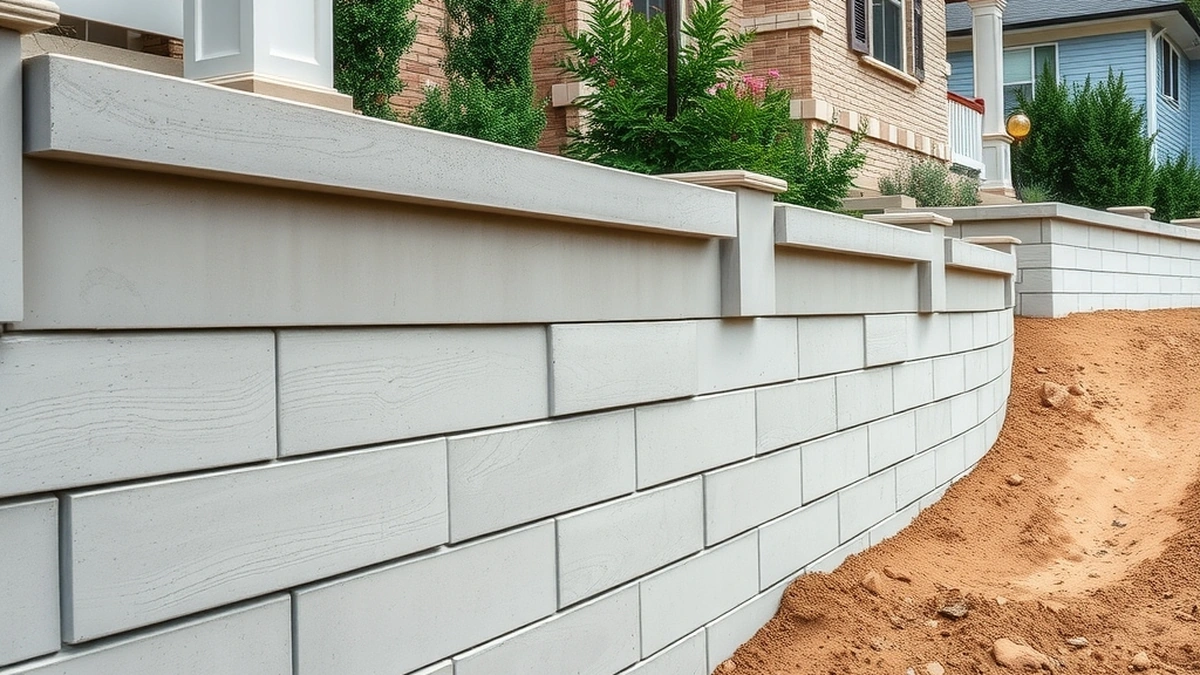
Poured concrete is a retaining wall cast in place as a single reinforced mass, usually on a spread footing with vertical and horizontal steel, formed on both faces or on one face against a neat excavation. Segmental block is a dry-stacked system of interlocking concrete units, commonly 8 inches high and 12 to 18 inches deep, laid on a compacted gravel base with geogrid layers tied back into the retained soil where the design calls for them.
That structural difference drives everything else. A poured wall carries load through its concrete section and footing; a block wall carries load through friction between units and, when reinforced, through geogrid.
Cost per square foot, with the arithmetic
Use a common residential wall: 40 feet long and 4 feet high. That is 40 × 4 = 160 square feet of wall face.
| System | Rate per sq ft | 160 sq ft of wall | Drainage and backfill |
|---|---|---|---|
| Poured concrete | $25-$60 | $4,000-$9,600 | $800-$2,400 |
| Segmental block | $15-$35 | $2,400-$5,600 | $800-$2,400 |
Poured concrete at the low end is 160 × $25 = $4,000; at the high end it is 160 × $60 = $9,600, where architectural faces and tight sites land. Segmental block runs 160 × $15 = $2,400 to 160 × $35 = $5,600, with caps, geogrid, and premium textures at the top of that range.
Drainage and backfill are quoted separately at $5 to $15 per square foot, so 160 × $5 = $800 to 160 × $15 = $2,400 applies to both systems. Added in, the 160 square foot wall lands at $4,800 to $12,000 in poured concrete, or $3,200 to $8,000 in block. Those are planning estimates, not bids; site access, soil type, and local labor rates move the numbers.
How each system handles soil pressure
Retained soil pushes horizontally, and the pressure grows with the square of the wall height. A 4 foot wall carries roughly a quarter of the overturning force of an 8 foot wall in the same soil, which is why a 4 foot wall is often a homeowner project and an 8 foot wall is usually an engineered one.
Poured concrete resists that push with mass and bending strength. The wall acts as a cantilever off its footing, so footing width and the steel schedule do the work. It tolerates being backfilled before drainage is complete far better than block does, though backfilling wet soil against any wall is a mistake.
Segmental block resists the same push with weight, friction, and, where specified, geogrid. It is a flexible system: it can deflect slightly under load without cracking, which helps on soils that move, and hurts if the movement is never arrested. A block wall built without geogrid on a tall or surcharged wall is the most common failure pattern in residential work.
Drainage and backfill
Both systems need a gravel chimney behind the wall, a perforated pipe at the base, filter fabric to keep fines out of the stone, and outlets that daylight downhill. That work is costed at $5 to $15 per square foot and is the cheapest insurance on the project.
Poured concrete hides its drainage. Weep holes are often the only visible clue, and clogged weep holes are common because the outlet sits at grade where soil and mulch collect. Segmental block is more forgiving because the joints between units pass water, but that same permeability means a block wall without a gravel chimney can saturate the soil directly behind the units and push the face outward.
If the wall retains a slope that sheds water toward it, divert surface flow uphill with a swale before you build. The pipe, gravel, and fabric details are covered in retaining wall drainage.
Build time, weather, and repairability
Poured concrete needs forms, steel, an inspection, a pour, and a cure. Weather matters: a pour in freezing conditions or heavy rain can ruin the face. The trade-off is a monolithic wall with no joints to open.
Segmental block goes up in a day or two on a small wall and needs no cure time. It can be built in light rain, stopped, and resumed. It can also be taken apart. If a section settles or a unit chips, you lift the cap, pull the affected units, re-level the base, and rebuild that run. Poured concrete repairs are cut-and-patch jobs that rarely match the original face.
The failure modes to watch for are covered in segmental block problems.
Where each one wins
Poured concrete wins when the wall is short and highly loaded, doubles as a structural element such as a basement wall or abutment, or must have a smooth, nearly watertight face.
Segmental block wins on cost, drainage, speed, repairability, and the look most homeowners want in a landscape. It is also the better choice where some settlement is likely, because a wall that can move slightly and still stand is safer than one that cracks.
| Question | Poured concrete | Segmental block |
|---|---|---|
| Typical rate | $25-$60 per sq ft | $15-$35 per sq ft |
| Footprint | Narrow | Wider base and grid zone |
| Drainage | Weep holes, hidden | Joints plus gravel chimney |
| Movement tolerance | Low | Moderate |
| Repair | Cut and patch | Disassemble and rebuild |
| Best use | Structural, watertight, tight lots | Landscape, budget, future changes |
How to choose
- Measure the exposed face and calculate square feet as length × height, then add 10 percent for steps, curves, and waste.
- Confirm the permit threshold in your jurisdiction. Many US building departments require a permit and engineered drawings above 4 feet, and some regulate lower walls that carry a surcharge such as a driveway.
- Price both systems at your actual square footage using the rates above, then add $5 to $15 per square foot for drainage and backfill to each total.
- Check the footprint each system needs. Block walls require a wider excavated base and often geogrid extending 3 to 5 feet behind the face, and on a tight lot that alone can decide the material.
- Get a geotechnical read if the wall retains a slope, sits on fill, or is near a foundation, then have the wall designed to that soil rather than to a rule of thumb.
For material-specific pricing, see poured concrete cost and block retaining wall cost. For the budget end of the market, timber vs segmental block covers how wood compares on the same measures.
Frequently asked questions
Is poured concrete cheaper than segmental block for a retaining wall?
No. Poured concrete typically runs $25 to $60 per square foot against $15 to $35 for segmental block, so block is usually the lower-cost system before drainage and backfill are added to either.
Which wall handles water better, poured concrete or block?
Segmental block sheds water through its joints and is easy to drain with a gravel chimney, while poured concrete relies on weep holes and hidden drains that clog if they are not maintained.
Can a segmental block wall be taller than a poured concrete wall?
Both can be built tall, but block walls above roughly 4 feet usually need geogrid design and engineering review, and poured walls need a designed footing and steel schedule at any height that carries a surcharge.
Which system is easier to repair after settlement?
Segmental block. Units can be lifted, the base re-levelled, and the run rebuilt, while poured concrete repairs are cut-and-patch work that rarely matches the original face.
Does poured concrete need a footing?
Yes. A poured retaining wall is a cantilever that depends on a designed spread footing and vertical steel, so the footing is part of the wall, not an optional extra.
Which is better for a tight property line?
Poured concrete needs less horizontal room because it does not require the wide gravel base and geogrid zone that a segmental block wall needs behind the face.
Sources
Some links are affiliate links.If you buy through them we may earn a commission at no extra cost to you. We do not accept payment for rankings. Read the full disclosure.