Poured Concrete Problems: Cracks, Spalling, and Leans
Which concrete wall cracks are cosmetic and which are structural, why spalling and honeycombing happen, and what each repair actually involves.
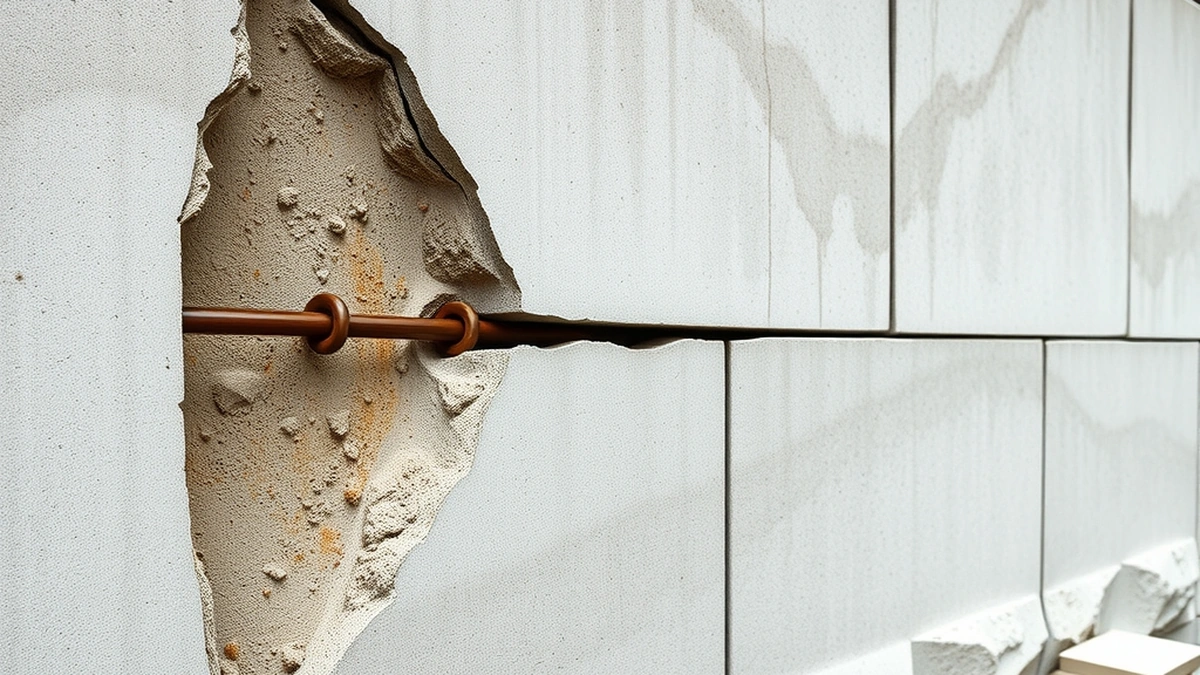
Most poured concrete problems are cracks, spalling, honeycombing, or movement. Hairline shrinkage cracks are cosmetic; cracks over 1/4 inch, horizontal cracks, and any lean are structural. Spalling means rebar is rusting, and honeycombing means a poorly consolidated pour.
- Cosmetic crack width
- Under 1/16 inch
- Structural warning
- 1/4 inch or wider
- Rebar cover
- 2 to 3 inches
- Wall cost to replace
- $25 - $60 per square foot
- Drainage to prevent it
- $5 - $15 per square foot
Some links on this page are affiliate links.If you buy through them we may earn a commission at no extra cost to you. We do not accept payment for rankings. Read the full disclosure.
Poured concrete problems fall into two groups: the ones concrete does to itself while curing, and the ones soil and water do to it afterward. Shrinkage cracks, honeycombing, and cold joints belong to the first group. Spalling, leaning, and structural cracking belong to the second. The width and direction of a crack tell you which group you are dealing with, and that decides whether the fix is a patch or a rebuild.
Reading a Crack
A crack is a message about what moved. The direction, width, and whether it is growing matter more than how it looks.
| Crack pattern | Likely cause | Response |
|---|---|---|
| Random hairline, under 1/16 in | Shrinkage during curing | Monitor, no repair needed |
| Vertical at regular spacing | Control joint working as designed | None |
| Vertical, wider than 1/4 in | Tension or settlement | Engineer assessment |
| Horizontal at mid-height | Bending from soil pressure | Engineer, structural |
| Diagonal from a corner | Differential settlement | Engineer assessment |
| Along a cold joint | Poor pour continuity | Inject or seal |
| Map cracking with white edges | Freeze-thaw or alkali reaction | Investigate source |
The single most useful measurement is width. A 1/16-inch crack is a hairline; a 1/4-inch crack is a structural question. Take a photograph with a ruler against the crack, and repeat it in six months.
Shrinkage and Curing Cracks
Concrete shrinks as it cures, and a wall restrained by a footing cannot shrink freely, so it cracks. That is why control joints exist: they give the shrinkage a defined line to open along, at 1.5 to 2 times the wall height.
Shrinkage cracks are usually vertical or random, narrow, and stable after the first year. They do not indicate a weak wall. They do indicate that curing was fast, which is common on a hot, windy pour without wet curing or curing compound.
Curing matters beyond cosmetics. Concrete reaches about 70 percent of its design strength in seven days and full strength at 28. A wall that was backfilled on day three carries soil load while it is still green, and the cracks that follow are structural, not cosmetic.
Structural Cracks
A horizontal crack is the one to take seriously. Soil pressure pushes the wall outward at mid-height, and the wall bends like a beam. A horizontal crack on the soil face means the bending tension exceeded the steel, which means the wall is under-reinforced for the load it is carrying.
Diagonal cracks radiating from a corner usually indicate that one part of the footing has settled more than another. Vertical cracks wider than 1/4 inch can be either settlement or a missing control joint that has become a real crack.
Any of these, plus a wall that is visibly bowing, is an engineer’s call. The failure guide covers how the assessment proceeds, and a wall above 4 feet should not be diagnosed from a photograph alone.
Spalling and Rebar Corrosion
Spalling is the surface breaking away in flakes or chunks, and its usual cause is corroding reinforcement. Steel expands as it rusts, and the expansion pushes the cover concrete off from behind.
The conditions for corrosion are a bar too close to the surface, water reaching it, and oxygen. Cover should be 2 to 3 inches on the soil face, and the waterproofing and drainage are what keep water away from that cover.
A proper repair means cutting back to sound concrete, cleaning the bar to bare metal, treating it with a corrosion inhibitor, and patching with a repair mortar matched to the wall’s strength. Painting over a spall hides it for one season.
Honeycombing and Cold Joints
Honeycombing is a cluster of voids where the aggregate has separated and the paste did not fill the spaces. It comes from inadequate vibration, a mix that is too stiff, or rebar spaced too tightly for the aggregate to pass.
Small areas can be cut back and patched. Widespread honeycombing means the wall’s cover is compromised across a large area, and the repair is closer to reconstruction than to patching.
A cold joint is a plane where one pour set before the next arrived. It is not a defect if it was planned and detailed with a keyway and waterstop. It is a defect if it happened by accident, because it is a straight path for water to reach the steel.
Drainage, Efflorescence, and Freeze-Thaw
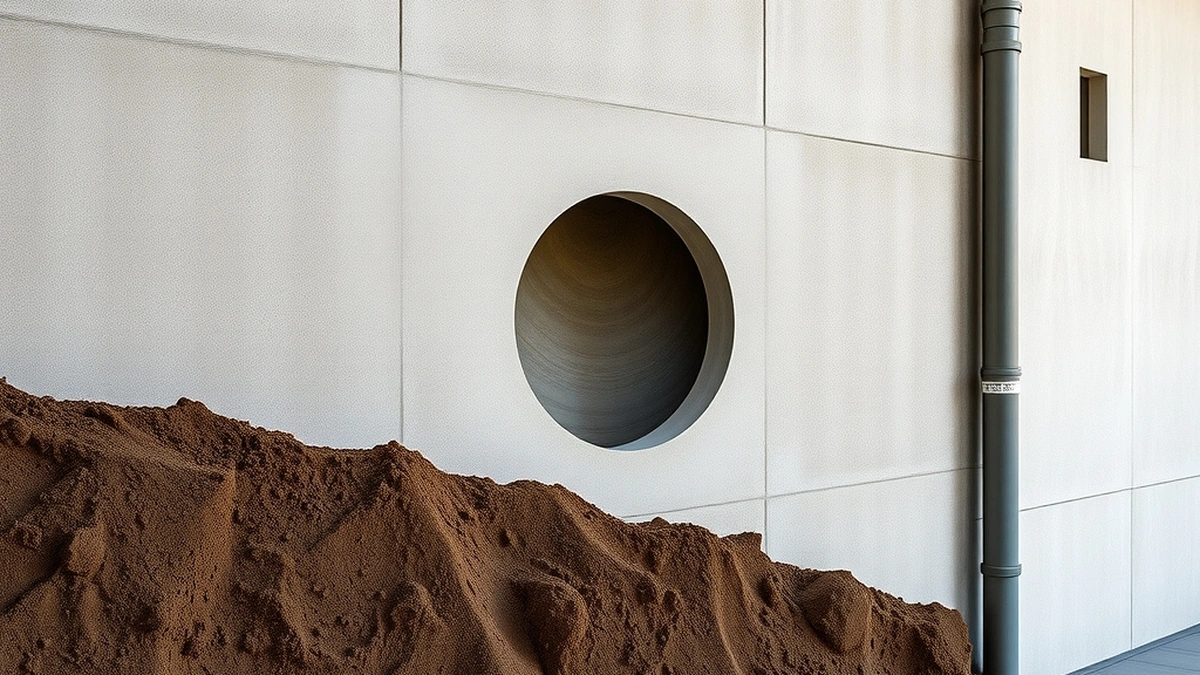
Water is behind most of the problems that are not curing defects. A wall with saturated backfill carries roughly double the lateral load of a dry one, and water finding its way through the concrete leaves efflorescence on the face as it evaporates.
Freeze-thaw damage shows as scaling on the exposed face and as pop-outs where a saturated surface layer freezes. Air-entrained concrete resists it; concrete placed without air entrainment in a cold climate does not.
The fix is upstream: waterproofing on the soil face, a gravel drainage layer, a perforated pipe, and a graded surface that sheds water away from the wall. That detail costs $5 to $15 per square foot, against $25 to $60 for the wall itself.
Leaning and Settlement
A wall that leans forward is rotating on its footing. The cause is usually a footing that was too narrow, soil that could not carry the bearing pressure, or water softening the soil beneath the toe.
Straightening is rarely economic. The footing and the soil under it are the problem, and pushing the wall back does not fix either. Most leaning residential walls are replaced, and the replacement includes a wider footing and better drainage than the original.
What to Do Next
- Photograph every crack with a ruler for scale, and note the date.
- Measure the wall’s lean with a level at three points, and compare against a string line.
- Check the drainage outlet and clear it, then watch whether water still stands behind the wall.
- Monitor for six months, and treat any crack that widens or any lean that increases as urgent.
- Call an engineer for horizontal cracks, cracks over 1/4 inch, spalling with exposed rebar, or any wall above 4 feet.
- Price the repair against replacement before committing, because a repair above 60 percent of replacement is usually the wrong spend.
For the repair methods themselves, see retaining wall repair and poured concrete maintenance. For what a replacement costs, read poured concrete cost, and for the drainage design that prevents most of this, retaining wall drainage.
Frequently asked questions
Are cracks in a concrete retaining wall normal?
Hairline cracks under about 1/16 inch are normal, especially in the first year as the concrete shrinks and cures. Cracks wider than 1/4 inch, horizontal cracks, and cracks that widen over time point to movement or overload and need an engineer.
Why is the concrete surface flaking off my wall?
That is spalling, and it usually means the rebar beneath has corroded. Corrosion expands the steel, which pushes the cover concrete off. The repair requires removing the loose material, treating the bar, and patching with a compatible repair mortar, not just filling the hole.
What causes honeycombing in a concrete wall?
Honeycombing is a network of voids left where the concrete was not vibrated properly or the mix was too stiff to flow around the rebar. It lets water reach the steel, so it has to be cut back to sound concrete and patched, not skimmed over.
Can a leaning concrete wall be straightened?
Rarely in a cost-effective way. A wall that has rotated on its footing usually needs to be replaced, because pushing it back does not restore the footing or the soil beneath it. Underpinning is possible on some walls but costs more than a rebuild in most residential cases.
What is efflorescence on a concrete wall?
A white salt deposit left when water moves through the concrete and evaporates at the surface. It is cosmetic, but it is evidence that water is getting in. Fix the drainage and the source before cleaning the face, or it returns.
Should I seal a poured concrete retaining wall?
The soil face should be waterproofed during construction. The exposed face is better left breathable, or treated with a penetrating silane or siloxane sealer rather than a film-forming coating that traps moisture and blisters.
Sources
Some links are affiliate links.If you buy through them we may earn a commission at no extra cost to you. We do not accept payment for rankings. Read the full disclosure.