Gabion Installation for Retaining Walls
Gabion installation step by step: base prep, geotextile, basket assembly, lacing, stone fill, and stepping, with cost figures for a US wall.
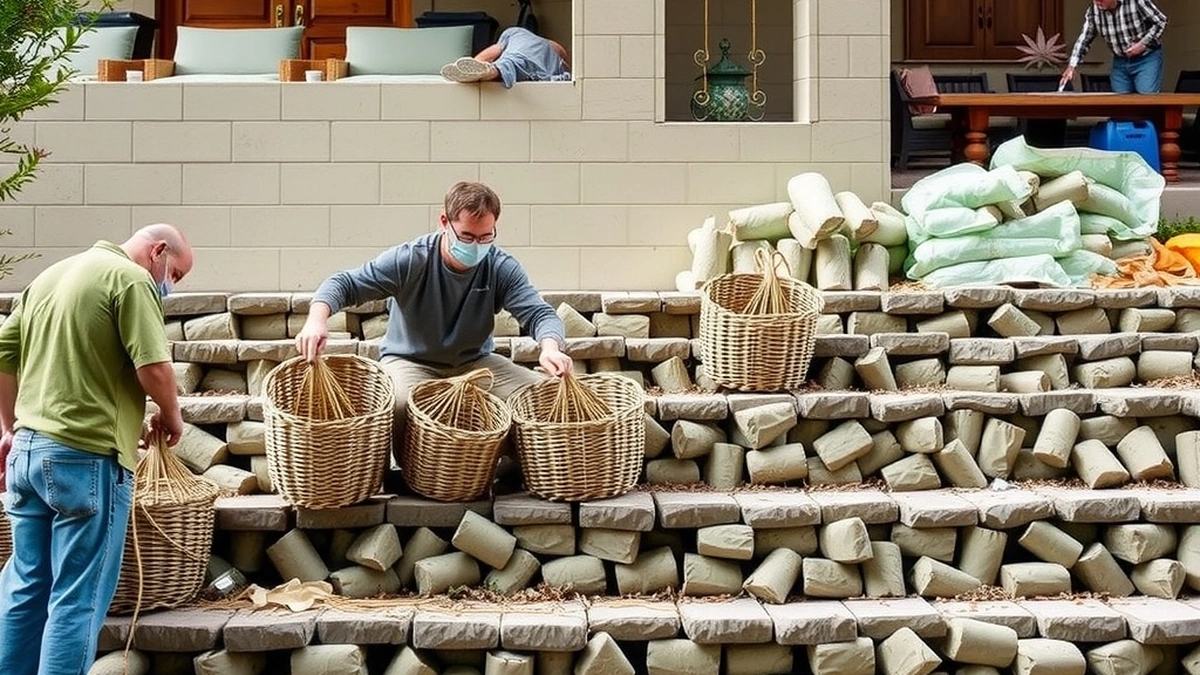
Gabion installation is base, fabric, baskets, fill: compact a level base, lay geotextile, assemble and lace the baskets, fill with angular stone, and step each course back. Installed cost is $20 to $40 per square foot.
- Installed rate
- $20-$40 per sq ft
- Basket size
- 3 x 3 x 3 ft common
- Stone size
- 4-8 in hard stone
- Step back
- 3-6 in per course
Some links on this page are affiliate links.If you buy through them we may earn a commission at no extra cost to you. We do not accept payment for rankings. Read the full disclosure.
Gabion installation follows a fixed order: level base, filter fabric, baskets, lacing, stone, and a stepped finish. Skip the base or fill with rounded rock and the wall bulges within a season. The work is simple but heavy, and the details that matter are all about keeping the basket square and the fill interlocked. Installed cost runs $20 to $40 per square foot, with stone supply usually the largest single line.
How a gabion wall carries load
A gabion wall is a gravity structure made of wire mesh baskets filled with stone, stacked in courses and stepped back as it rises. The mass of the stone resists the soil behind it. There is no geogrid and no concrete footing, so everything depends on the base and on the fill staying dense.
Because the fill is stone, water passes through the wall rather than building pressure behind it. That is the system’s main advantage on wet sites, and it only works if the stone is clean and the fabric behind it keeps soil fines from washing into the voids.
Baskets, sizes, and stone
Common residential baskets are 3 × 3 × 3 feet, 6 × 3 × 3 feet, and 3 × 3 × 1.5 feet, with the shallower units used for the top course so the wall can be finished cleanly. Wire is typically galvanized, with PVC coating for coastal or salt-exposed sites.
Fill should be hard, angular stone in the 4 to 8 inch range, with enough size variation that the pieces lock.
| Basket | Typical use | Fill size |
|---|---|---|
| 3 x 3 x 3 ft | Standard course | 4-8 in angular stone |
| 6 x 3 x 3 ft | Long straight runs | 4-8 in angular stone |
| 3 x 3 x 1.5 ft | Top course | 4-6 in stone |
Stone quantity is worth working out before you order. A 3 foot high, 3 foot deep wall holds 9 cubic feet per linear foot, so 40 feet holds 360 cubic feet, or 360 ÷ 27 = 13.3 cubic yards. At roughly 1.5 tons per cubic yard that is about 20 tons. Full pricing is in gabion cost.
The installation sequence
- Excavate to a level bench and compact a 6 to 12 inch gravel base along the full length of the wall, checking level every 10 feet.
- Line the soil side with geotextile, overlapping seams by at least 12 inches and leaving enough fabric to fold up over the backfill later.
- Assemble each basket flat, fold up the sides and ends, and lace every corner and edge with galvanized wire on a continuous spiral.
- Set the first course tight against the fabric, lacing each basket to its neighbour along all touching edges, and tension the internal brace wires.
- Fill each basket in two or three lifts, placing stone by hand at the faces and dropping the rest in, then close and lace the lid.
- Step the next course back 3 to 6 inches, repeat the fill and lacing, and finish with a shallow top course or a stone cap.
Hand-place the face stones. A basket filled by dropping stone straight in will have loose faces that bulge once the wall is loaded.
Lacing, bracing, and shape
Lacing is the part that gets rushed. Every edge that touches another basket should be laced, and internal brace wires should be tensioned so the basket does not belly out when filled. A basket that is out of square cannot be corrected after it is full.
Use the wire supplied with the baskets or a comparable galvanized tie. Plastic zip ties are not a substitute at the base or on structural edges; they degrade in sunlight and fail under load.
Check squareness as you go. A basket that is 2 inches out of square at the base will be 2 inches out at the top, and the courses above will not sit flat.
Base, excavation, and slope
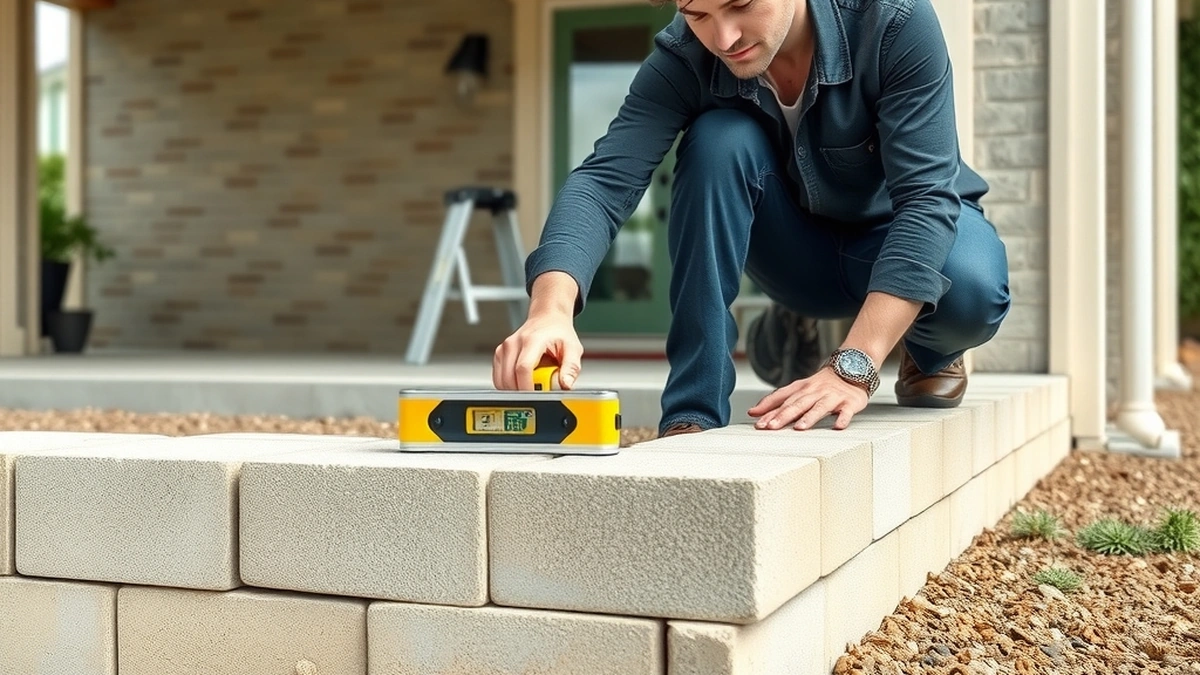
The base is where most amateur gabion walls fail. The subgrade must be firm, the gravel must be compacted in lifts, and the finished base must be level along the wall line. A base that follows the ground slope tilts the baskets and starts the wall moving.
On a slope, step the excavation. Each basket sits on its own level bench, and the wall steps up the hill in increments rather than sitting on a rake. That means more excavation than most people expect, and it is not optional.
Keep the base below the frost depth in cold climates, or use a drained gravel layer thick enough that frost cannot lift the wall. A heaved gabion wall is expensive to fix because the baskets must be cut open.
Geotextile and backfill
Geotextile separates the stone fill from the soil behind it. Without it, fines migrate into the voids, the wall stops draining, and the retained soil loses strength. Overlap seams generously and fold the fabric up over the top of the backfill before you place soil.
Backfill behind the wall should be compacted in lifts, and the top surface should slope away from the wall. Water that runs over the top of a gabion wall enters the fill from above, which is the one direction the system is not designed to handle.
Where the wall retains a slope, intercept surface flow above it with a swale. The general drainage principles are the same as for any wall and are set out in retaining wall drainage.
Inspection before you call it done
Walk the finished wall and check four things: the line is straight or evenly curved, the courses are stepped consistently, every lid is laced down, and no basket face is bulging. Push on a few faces; a properly filled basket should feel solid, not springy.
Check the top of the wall for loose stone that could fall, and confirm the fabric is not visible through the face. Then check the ground above the wall slopes away and the swale, if present, drains somewhere sensible.
Cost and effort
Materials and labor together run $20 to $40 per square foot of face, so a 40 foot by 4 foot wall at 160 square feet is $3,200 to $6,400. Owner labor can cut the total substantially if stone is available cheaply, but the base, fabric, and lacing still have to be done properly.
Gabion suits a wet slope, a rural site, or a wall where a natural stone look is wanted. It is a poor fit where baskets will be hit by vehicles, where stone must be carried by hand more than about 50 feet, or where the wall must be finished with a precise top edge. The failure modes are in gabion problems, upkeep is in gabion maintenance, and the material comparison is in gabion wall cost.
Frequently asked questions
What size stone goes in gabion baskets?
Hard, angular stone between about 4 and 8 inches, with a mix of sizes so the fill locks together. Rounded river rock and soft stone both pack poorly and allow the baskets to bulge.
How deep should the base be for a gabion wall?
A compacted gravel base 6 to 12 inches deep is typical for a residential wall, placed on firm subgrade and levelled along the whole length before any basket is set.
Do gabion baskets need to be tied together?
Yes. Adjacent baskets are laced along every touching edge with galvanized wire or heavy-duty ties, and internal brace wires are tensioned so the basket keeps its shape when it is filled.
How much should a gabion wall step back per course?
Common practice is 3 to 6 inches of setback per 3 foot course, which puts the wall's center of mass behind the toe and improves stability without looking obviously stepped.
Can I install a gabion wall on a slope?
Yes, provided the base is stepped into the slope rather than laid on the surface. Each basket must sit on level ground, so a sloping site means a stepped excavation, not tilted baskets.
How long does a gabion installation take?
A 40 foot long, 4 foot high wall is typically two to four days for a small crew, with fill and lacing the slowest parts. Stone delivery and site access usually set the schedule more than the building does.
Sources
Some links are affiliate links.If you buy through them we may earn a commission at no extra cost to you. We do not accept payment for rankings. Read the full disclosure.