Gabion Cost for a Retaining Wall
Gabion cost for a retaining wall: per square foot, per ton, and per basket, with worked arithmetic for stone, geotextile, base, and labor.
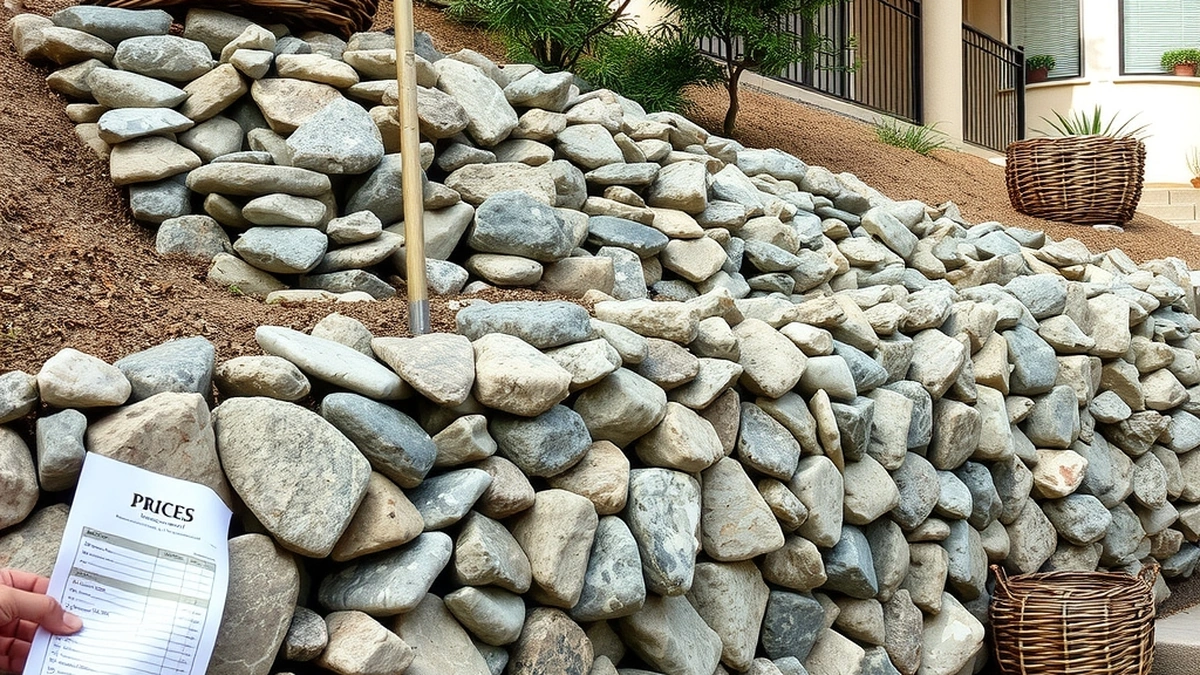
Gabion walls cost $20 to $40 per square foot installed, including baskets, stone, and labor. A 40 foot by 4 foot wall at 160 square feet runs $3,200 to $6,400.
- Installed rate
- $20-$40 per sq ft
- 160 sq ft wall
- $3,200-$6,400
- Stone per cubic yard
- About 1.5 tons
- Biggest variable
- Stone source and access
Some links on this page are affiliate links.If you buy through them we may earn a commission at no extra cost to you. We do not accept payment for rankings. Read the full disclosure.
Gabion walls cost $20 to $40 per square foot installed, which puts them above segmental block and below poured concrete on most US residential projects. The number covers galvanized or PVC-coated baskets, stone fill, geotextile, base preparation, and labor. What moves a quote outside that band is rarely the basket price; it is stone supply, haul distance, and whether a machine can reach the wall line.
What a gabion wall is
A gabion wall is a stack of wire mesh baskets filled with stone, tied together and stepped back slightly as it rises, so the mass of stone resists the soil behind it. The fill is free-draining by design, which is why gabion walls handle wet sites and seepage better than solid walls.
It is a gravity structure. There is no geogrid and no concrete footing in a typical residential gabion wall, just a compacted base, geotextile against the soil, and enough basket depth for the wall’s mass to resist overturning.
The cost per square foot, with the arithmetic
Use a 40 foot wall at 4 feet high: 40 × 4 = 160 square feet of wall face.
At the low end, 160 × $20 = $3,200. At the high end, 160 × $40 = $6,400. That is the installed range for a site with reasonable access and a local stone supply.
The same wall in other materials, priced the same way, shows where gabion sits:
| System | Rate per sq ft | 160 sq ft wall |
|---|---|---|
| Timber | $10-$25 | $1,600-$4,000 |
| Segmental block | $15-$35 | $2,400-$5,600 |
| Gabion | $20-$40 | $3,200-$6,400 |
| Boulder | $20-$45 | $3,200-$7,200 |
| Poured concrete | $25-$60 | $4,000-$9,600 |
Gabion at 160 square feet lands within $800 of boulder at the low end and matches it at the top, which is why the two are usually compared on appearance and stone availability rather than price alone. The wider comparison is in retaining wall cost per square foot.
Where the money actually goes
The installed rate is a blend of four line items. Breaking them out is the only way to judge a quote.
| Line item | Share of a typical quote | Notes |
|---|---|---|
| Baskets and ties | 15-25 percent | Galvanized cheaper, PVC-coated higher |
| Stone fill | 25-40 percent | Sold by the ton, not the basket |
| Geotextile and base | 5-10 percent | Compacted gravel and filter fabric |
| Labor and equipment | 30-45 percent | Fill and lacing are hand work |
Those shares are planning estimates, not a rate card. On a site where stone must be hauled 40 miles, the stone share climbs and the labor share falls. On a site where a machine cannot reach the wall, the labor share climbs hard.
Stone quantity, worked out
Gabion cost is driven by stone volume, and stone is sold by weight. A wall 3 feet high and 3 feet deep contains 3 × 3 = 9 cubic feet of stone per linear foot. For 40 feet: 40 × 9 = 360 cubic feet. There are 27 cubic feet in a cubic yard, so 360 ÷ 27 = 13.3 cubic yards.
Gabion stone weighs roughly 1.5 tons per cubic yard, so 13.3 × 1.5 = about 20 tons. At a planning figure of $60 per ton delivered, that is 20 × $60 = $1,200 of stone. At $100 per ton, 20 × $100 = $2,000. That single variable accounts for most of the spread between a $3,200 wall and a $6,400 one.
If the wall is 4 feet high, the volume grows: 4 × 3 = 12 cubic feet per linear foot, 40 × 12 = 480 cubic feet, 480 ÷ 27 = 17.8 cubic yards, and 17.8 × 1.5 = about 27 tons. Note that the square foot rate did not change, but the tonnage did, because the wall is deeper.
Site access, excavation, and haul-off
A gabion wall is heavy in both directions. Stone arrives by truck and must get within reach of the wall line; spoil from excavation must leave the same way. On a rear lot with a 3 foot gate, the labor line can double because every basket and every bucket of stone moves by hand.
Excavation is the other hidden cost. A gabion wall needs a level, compacted base and a stepped excavation behind it, and on a slope that means cutting into the hill. Rock, roots, and old footings all add time.
Ask whether the quote includes haul-off of spoil. It is often excluded, and a single truckload of soil removal is a real line item on a small job.
Drainage and what you still need
Gabion walls drain through the fill, so they need far less gravel than a solid wall. They do not need zero. Geotextile must be placed between the baskets and the soil to stop fines washing into the stone and clogging it, and the base must be compacted gravel so the bottom basket does not settle into mud.
Most budgets should still carry a drainage allowance of $5 to $15 per square foot for excavation, geotextile, and base, which on 160 square feet is 160 × $5 = $800 to 160 × $15 = $2,400. Some of that is already inside the $20 to $40 rate; the point is to confirm which, rather than assume.
How to budget a gabion wall
- Measure the face as length × height, add 10 percent for stepping and curves, and multiply by $20 to $40 to get the installed range.
- Calculate stone volume as height × depth × length in feet, divide by 27 for cubic yards, then multiply by 1.5 for tons.
- Call two local stone suppliers for a delivered price per ton, because that is the number that decides whether your project sits at $20 or $40 per square foot.
- Ask each contractor whether the quote includes excavation, spoil haul-off, geotextile, and base compaction, and get the answer in writing.
- Confirm the basket coating and wire gauge in the specification, since PVC-coated baskets cost more and last longer in coastal or salt-exposed sites.
- Compare against block and boulder on the same square footage before committing, using the table above.
A gabion wall is a good buy on a wet slope where a solid wall would need extensive drainage, and a poor buy on a dry, accessible site where block is cheaper and easier to finish. The build sequence is in gabion installation, the failure modes to price against are in gabion problems, and the stone-versus-basket trade-off is covered in gabion vs boulder. For a like-for-like material comparison, see gabion wall cost.
Frequently asked questions
How much does a gabion wall cost per square foot?
Installed gabion walls typically run $20 to $40 per square foot of wall face, which includes the mesh baskets, stone fill, geotextile, base preparation, and labor for a straightforward residential site.
Is gabion cheaper than segmental block?
Usually not. Gabion runs $20 to $40 per square foot against $15 to $35 for segmental block, so block is generally the lower-cost option unless stone is available cheaply on site.
What is the biggest cost driver in a gabion wall?
Stone supply and site access. Gabion fill is heavy, so haul distance and whether a machine can reach the wall line often matter more than the basket price.
Do gabion walls need drainage and backfill?
Less gravel than a solid wall because the stone fill is permeable, but they still need a compacted base, geotextile against the soil, and excavation, which is why a drainage allowance of $5 to $15 per square foot still applies in most budgets.
How much stone does a gabion wall need?
A 3 foot high, 3 foot deep wall uses 9 cubic feet of stone per linear foot, so 40 feet uses 360 cubic feet, or about 13.3 cubic yards, which is roughly 20 tons at 1.5 tons per cubic yard.
Can gabion cost less if I fill the baskets myself?
Yes, if you have a cheap stone source and the equipment to move it. Labor is a large share of the installed rate, so owner-supplied stone and owner labor can cut the total substantially, but the wall still needs a proper base and geotextile.
Sources
Some links are affiliate links.If you buy through them we may earn a commission at no extra cost to you. We do not accept payment for rankings. Read the full disclosure.