Stone Retaining Wall Cost: Dry, Mortared, and Cut
Stone retaining walls run $20 to $45 per square foot dry-stacked, with mortared cut stone priced above that. Stone types, tonnage math, and real budgets.
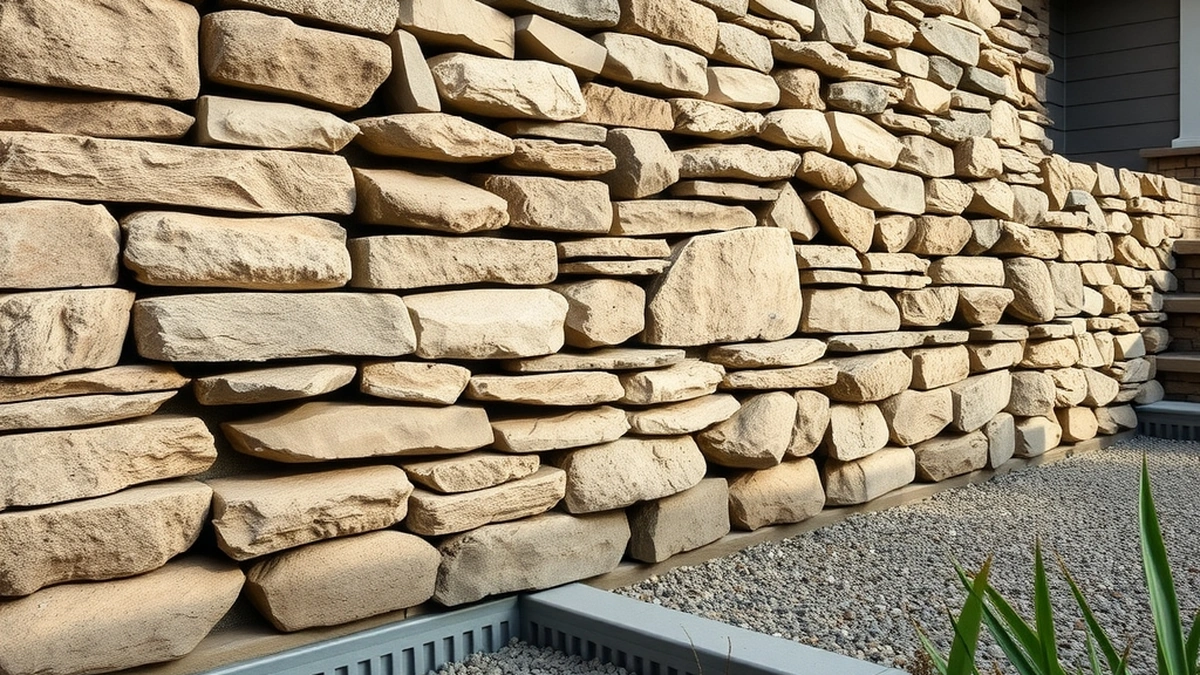
A dry-stacked stone wall costs $20 to $45 per square foot of face installed, plus $5 to $15 for drainage. Mortared cut stone runs higher because of the footing and masonry labor, commonly $45 to $90 per square foot. Stone is priced by weight and by the hour.
- Dry stone wall
- $20 - $45 per square foot
- Drainage and backfill
- $5 - $15 per square foot
- Mortared cut stone, estimated
- $45 - $90 per square foot
- Stone per square foot of face
- About 100 to 150 pounds
- Typical 120 sq ft wall
- $5,400 dry-stacked
Some links on this page are affiliate links.If you buy through them we may earn a commission at no extra cost to you. We do not accept payment for rankings. Read the full disclosure.
Stone retaining wall cost is the price of the stone, the labor to shape and place it, and the drainage that keeps water from pushing the wall over, and it runs $20 to $45 per square foot of wall face for a dry-stacked wall. Drainage adds $5 to $15 per square foot. Mortared cut stone sits above that range, commonly $45 to $90 per square foot, because it adds a concrete footing, mortar, and far more skilled hours.
What the Price Is Made Of
Stone walls are labor-priced more than material-priced. A block wall is a stacking job with uniform units; a stone wall is a fitting job where every stone is turned, chipped, and set. That difference shows up in the rate even when the stone itself is cheap.
The three components are the stone, delivered; the base preparation, which is compacted gravel over undisturbed soil; and the placement labor, which rises steeply with wall height and with the amount of shaping the stone needs. Fieldstone with rounded faces takes longer to lay stable than flat-bedded sandstone, and that labor difference is larger than the price difference between the two materials.
Dry Stone Versus Mortared Stone
| Feature | Dry-stacked | Mortared |
|---|---|---|
| Typical rate | $20–$45 per sq ft | $45–$90 per sq ft, estimated |
| Footing | Compacted gravel | Concrete below frost line |
| Drainage | Weeps through the face | Weep holes and gravel |
| Base width | About half the height | 12 to 18 inches on a footing |
| Skill required | High | High, plus masonry |
| Repairability | Individual stones can be reset | Mortar joints must be cut out |
| Best for | Garden walls, rural sites, period look | Structural walls, tight spaces, veneer |
Dry stone is not a cheaper version of mortared stone; it is a different structure. It relies on gravity, friction, and careful batter rather than on a bond. That is why it can drain through the face and why it survives movement that would crack a mortared joint.
Stone Types and What They Cost
Fieldstone. Locally gathered, irregular, often the cheapest per ton and the slowest to lay. Good for low garden walls.
Granite. Hard, dense, and expensive to cut. It lasts essentially indefinitely and prices at the top of the dry range.
Limestone. Softer, easier to shape, widely available in the Midwest and South. It wears faster at the top course where water sits.
Sandstone. Flat-bedded and easy to stack, which lowers labor. Some sandstone is too absorbent for freeze-thaw climates.
Basalt. Very hard and heavy, common in the Pacific Northwest. High material cost, low breakage.
The stone type changes the material line by perhaps 20 to 40 percent, but it can change the labor line by more, because flat stone stacks faster than round stone.
Three Worked Budgets
Garden wall, 40 square feet. Dry stone, 2 feet high by 20 feet long.
Stone and labor at $32: 40 × $32 = $1,280. Drainage at $8: 40 × $8 = $320. Total: $1,600, or $40 per square foot.
Residential wall, 120 square feet. Dry stone, 4 feet high by 30 feet long.
Stone and labor at $35: 120 × $35 = $4,200. Drainage at $10: 120 × $10 = $1,200. Total: $5,400, or $45 per square foot.
Mortared cut stone, 120 square feet. 4 feet high by 30 feet long.
Stone, footing, mortar, and masonry at $75: 120 × $75 = $9,000. Drainage at $12: 120 × $12 = $1,440. Total: $10,440, or $87 per square foot, before engineering.
The gap between the second and third examples is the footing and the mortar work, not the stone. If the wall is under 3 feet and freestanding, dry stone usually delivers the same look for roughly half.
How to Estimate Stone Quantity
Stone is sold by the ton, and the tonnage depends on wall thickness. For a wall about 2 feet thick at the base, plan on 100 to 150 pounds per square foot of face.
A 120-square-foot wall at 125 pounds per square foot:
120 × 125 = 15,000 pounds, or 7.5 tons.
Add 10 percent for breakage and shaping: 7.5 × 1.1 = 8.25 tons. At $150 to $300 per ton delivered for fieldstone, that is $1,238 to $2,475 in material, or $10 to $21 per square foot. The balance of the installed rate covers labor, base gravel, and drainage.
Where the Money Actually Goes
On a dry stone wall, labor is usually the largest line, often 50 to 65 percent of the total. Two masons can lay perhaps 15 to 25 square feet of face per day on shaped stone, less on rounded fieldstone. At a loaded crew rate of $60 to $90 per hour, that works out to $25 to $50 per square foot in labor before any material.
That is the number to interrogate in a bid. A quote far below the local range usually means thinner walls, less batter, or no drainage gravel, not a better deal. The boulder cost guide covers the related case where large individual stones replace stacked ones.
How to Compare Stone Bids
- Measure the face area, then divide each bid by it to get a cost per square foot.
- Ask for the specified base width and batter, because a thinner wall is cheaper and weaker.
- Confirm the stone type, source, and delivered tonnage, and whether the price is per ton or per load.
- Require the drainage detail in writing: gravel envelope, filter fabric, and an outlet at the toe.
- Check whether the quote includes excavation, haul-off of spoil, and a concrete footing if mortared.
- Ask what happens if the stone runs short, since a second delivery often carries a minimum charge.
For the block alternative at $15 to $35 per square foot, see segmental block cost. For how the wall should drain regardless of material, read retaining wall drainage, and for the full material comparison, retaining wall cost.
Frequently asked questions
How much does a stone retaining wall cost per square foot?
Dry-stacked natural stone runs $20 to $45 per square foot of wall face installed, including material and labor. Add $5 to $15 per square foot for drainage gravel, pipe, and filter fabric. Mortared cut stone is a different scope and typically prices well above the dry range.
Is a stone wall cheaper than a block wall?
Usually not. Segmental block runs $15 to $35 per square foot installed, while dry stone starts at $20. Stone can still win on a rural site with cheap local fieldstone and on a wall where the look matters, but the labor hours per square foot are higher.
How much stone do I need for a retaining wall?
Plan on roughly 100 to 150 pounds of stone per square foot of wall face for a wall about 2 feet thick at the base. A 120-square-foot wall therefore needs about 6 to 9 tons. Order 10 percent extra for breakage and shaping.
How thick does a dry stone wall need to be?
A common rule is a base width of about half the wall height, tapering to 12 to 18 inches at the top. A 4-foot wall therefore starts around 24 inches wide at the base. The wall also batters back roughly 2 inches per foot of height.
Does a stone wall need a concrete footing?
A dry-stacked wall usually sits on compacted gravel and undisturbed soil, not concrete. A mortared wall needs a concrete footing below the frost line. Both need a drainage layer and a way for water to escape at the toe.
How long does a stone retaining wall last?
A well-built dry stone wall can last well over a century, and many survive several. Mortared stone lasts 50 to 100 years depending on the mortar and freeze-thaw exposure. Longevity depends more on drainage and base preparation than on the stone itself.
Sources
Some links are affiliate links.If you buy through them we may earn a commission at no extra cost to you. We do not accept payment for rankings. Read the full disclosure.